Content Refresh Strategy for AI Search: What to Update, Merge or Leave Alone
Learn how to refresh old content for SEO and AI search without fake freshness using Search Console data, content gaps, consolidation and evidence updates.

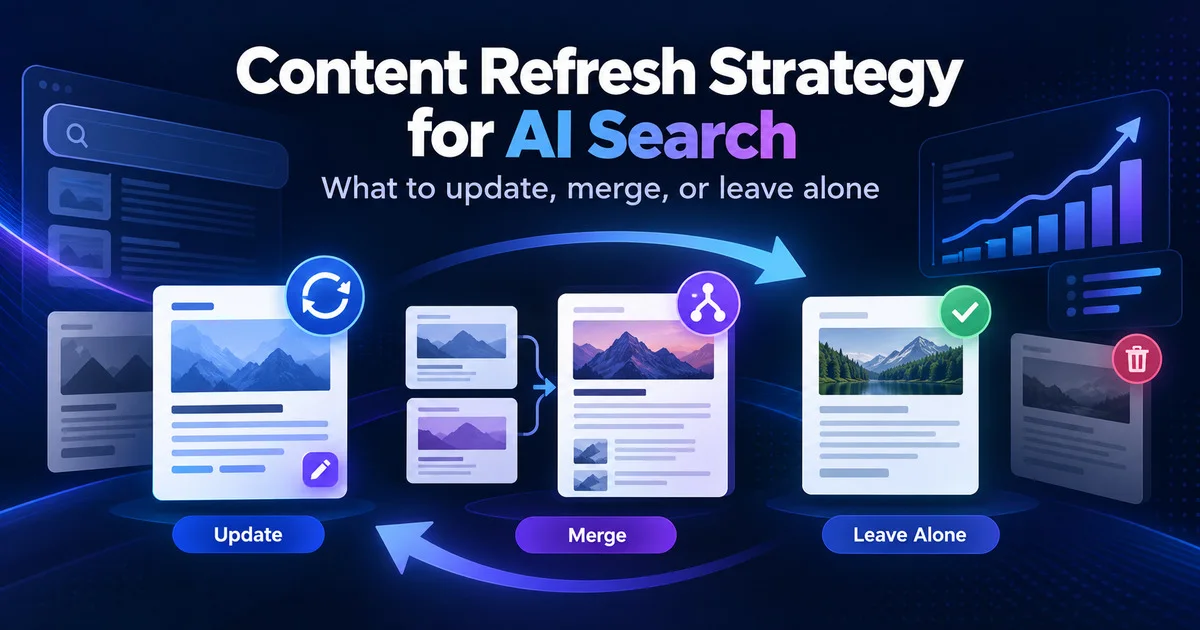
A content refresh strategy is the process of deciding which existing pages should be updated, expanded, merged, redirected or left alone. In 2026, this is more important than publishing endless new articles because AI search and traditional search both reward content that remains useful and accurate.
The key is to refresh for a reason.
Changing a date from 2025 to 2026 without improving the page is not a strategy.
Google specifically warns against changing dates just to make content look fresh.
Why old content loses performance
A page can decline for several reasons:
- Search intent changed.
- Competitors published better resources.
- Facts became outdated.
- The page lost internal links.
- Multiple pages started competing for the same topic.
- The title no longer matches current language.
- Product screenshots or features changed.
- The article never had enough unique value.
- Search results changed because AI features now answer part of the query directly.
Your refresh should respond to the actual cause.
Build a refresh inventory
Export your main content URLs into a spreadsheet.
Add:
- URL.
- Title.
- Publish date.
- Last real update.
- Search impressions.
- Clicks.
- Average position.
- Conversions.
- Backlinks.
- Internal links.
- AI citations if you track them.
- Business importance.
Then classify each page.
The five content decisions
1. Keep
The page is accurate, useful and performing.
Do not update it only because it is old.
2. Refresh
The page still matches the intent but needs:
- New facts.
- Better examples.
- Stronger structure.
- Updated screenshots.
- New source links.
- A better introduction.
3. Expand
The page is useful but misses important subtopics.
Add sections only when they help the reader.
4. Merge
Two or more pages compete for nearly the same intent.
Choose the strongest URL, combine the best material and redirect the weaker URL.
5. Remove
The page has no useful purpose, no meaningful links and no reason to remain live.
Use a proper status or redirect depending on whether there is a relevant replacement.
How to identify a good refresh candidate
High impressions, low clicks
The page may have:
- Weak title.
- Weak description.
- Wrong intent.
- Stronger SERP competition.
Check the live search results before rewriting.
Rankings fell gradually
Review:
- Competitor changes.
- Content freshness.
- Search intent.
- Internal links.
- Page experience.
- Content differentiation.
Traffic is stable but conversions are weak
The article may need a better next step rather than more SEO text.
AI citations exist but clicks are low
Improve the page so the citation leads to something worth visiting:
- A template.
- A deeper workflow.
- A tool.
- Original data.
- A clear next step.
Refresh for information gain
The best update is often not “more content.”
Ask what new value you can add.
Use the Information Gain SEO guide to identify:
- New evidence.
- New examples.
- Better frameworks.
- Original tables.
- Clearer decisions.
If the old page is generic, the refresh should make it less generic.
Update facts and primary sources
Platform-dependent articles can age quickly.
For example:
- Google Search features.
- Ad platform policies.
- AI crawler documentation.
- Analytics interfaces.
- Social platform features.
- Pricing.
- Software capabilities.
Use current primary documentation when possible.
Remove dead source links.
Do not keep an old statistic only because it sounds impressive.
Improve internal links during every refresh
A refresh is a good time to connect the page to newer content.
Check:
- Which new articles should link in?
- Which older articles should link out?
- Is there a stronger hub page?
- Are any anchor texts vague?
- Are there orphaned pages?
For example, a page about AI visibility can link to:
The links should help the reader continue the task.
Do not create fake freshness
Google's people-first guidance explicitly warns against changing dates to make pages seem fresh when the content has not substantially changed.
A real update should be visible in the article.
Examples:
- New section.
- Revised recommendation.
- Updated policy.
- New data.
- Reworked examples.
- Improved workflow.
If you make only a typo fix, you do not need to market the page as newly updated.
Content refresh and AI search
AI systems can use fresh web retrieval, but freshness only matters when the topic requires it.
A historical explanation can remain stable for years.
A guide to Google AI features may need regular review.
Classify topics by freshness need:
| Topic | Refresh frequency |
|---|---|
| Evergreen fundamentals | Low |
| Software interface | Medium |
| Platform policy | High |
| Pricing | High |
| Research statistics | Medium to high |
| Personal methodology | When process changes |
This prevents unnecessary editing.
A quarterly refresh workflow
Step 1: Pull data
Use Search Console, analytics and your AI visibility tracking.
Step 2: Select 10 to 20 candidates
Do not try to rewrite the entire site.
Step 3: Diagnose the problem
Assign one reason for the refresh.
Step 4: Write the update brief
Define:
- What is outdated.
- What the reader now needs.
- What unique value will be added.
- Which sources need updating.
- Which pages need internal links.
Step 5: Update and validate
Check:
- Title.
- Description.
- Headings.
- Canonical.
- Structured data.
- Links.
- Mobile layout.
- Date modified.
Step 6: Measure after recrawl
Track whether:
- Impressions improve.
- CTR improves.
- Rankings stabilize.
- Citations change.
- Conversions improve.
When to merge articles
Merge when two pages answer the same intent.
Warning signs:
- Same primary query.
- Same SERP competitors.
- Same section structure.
- Internal links feel forced because the pages are duplicates.
- One page ranks while the other rarely appears.
A merge can create a stronger canonical resource.
When not to merge
Keep separate pages when the user tasks are different.
For example:
- “What is AI visibility?” is a definition.
- “How to track AI visibility?” is a measurement workflow.
- “AI search ROI” is business attribution.
They belong in one cluster but serve different intents.
A refresh score
You can prioritize pages with a simple score.
Give one point for each:
- Search impressions declined.
- Content is factually outdated.
- Page has business value.
- Page already has backlinks.
- Page ranks on page two.
- Competitors improved.
- Conversion path is weak.
- AI citations are possible.
- Internal links are weak.
Pages with higher scores deserve attention first.
Use a diagnosis matrix before rewriting
A simple matrix can prevent unnecessary updates.
| Signal | Likely issue | First action |
|---|---|---|
| Impressions up, CTR down | SERP or title mismatch | Review search results and title |
| Impressions down, ranking stable | Demand changed | Check query trends |
| Ranking down, intent changed | Content no longer matches | Rebuild around current intent |
| Traffic stable, conversions down | Page journey problem | Improve CTA and offer |
| Two URLs swap rankings | Cannibalization | Consider merging |
| AI citations rise, clicks stay low | Zero-click influence | Improve deeper on-page value |
The purpose is to diagnose before you write.
Preserve URLs that already have value
When refreshing, avoid changing the URL simply because the title changes.
A stable URL can preserve:
- Backlinks.
- Search history.
- Internal links.
- Bookmarks.
- Existing citations.
Change the URL only when the structure or topic genuinely requires it, and use a proper redirect.
Keep a change log for important pages
For high-value evergreen guides, keep internal notes about:
- What changed.
- Why it changed.
- Which sources were updated.
- Which screenshots were replaced.
- Which sections were added or removed.
This makes future refreshes faster and reduces the risk of repeatedly undoing useful work.
You do not have to publish the full change log, but the editorial process should be traceable.
Do not over-refresh stable pages
A page that ranks, converts and remains accurate may need no major change.
Constant rewrites can remove the exact language or structure that made the page useful.
Use evidence before editing.
Final takeaway
A content refresh strategy is not about making everything look new.
It is about making the site more accurate, more useful and less redundant.
Update pages when the facts, intent or opportunity changed. Merge competing articles. Remove content that serves no purpose. Keep strong evergreen pages stable.
That approach supports both traditional SEO and AI search without falling into the fake-freshness trap.
Co-Founder of Strat IQ Digital and builder of CrawlerQue and Stratly Digital, based in West Palm Beach, FL. I work on AI products, SaaS, SEO intelligence, CRM automation and growth systems.