Entity SEO in 2026: Build a Brand Google and AI Systems Can Understand
Learn how to strengthen entity signals, structured data, author identity and brand consistency so search engines and AI systems can understand your business.

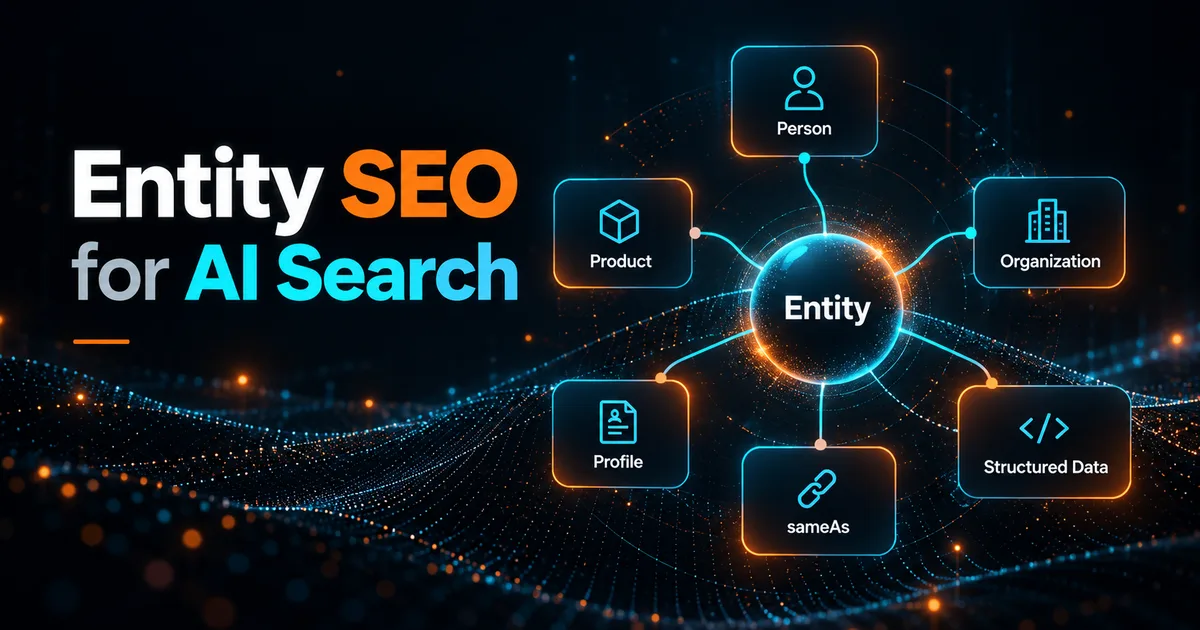
A modern SEO strategy needs more than keywords. Search engines and AI systems also need to understand who you are, what your organization does, which products belong to you, and how the people, brands, pages and profiles on your site relate to each other.
That is the practical purpose of entity SEO.
Entity SEO is not a secret schema trick and it is not a shortcut to a Knowledge Panel. It is the work of making your identity and relationships unambiguous across your website and the wider web. When those signals are consistent, search systems have fewer reasons to confuse your brand with another company, person or product.
For a personal brand or SaaS founder, this matters because one site may contain a person, a company, multiple products, social profiles and dozens of articles. If those connections are vague, the site can look like a collection of pages instead of a coherent source.
Google's documentation says Organization structured data can help Google understand administrative details and disambiguate an organization. Properties such as url, logo and sameAs can help connect an organization to the correct external profiles. That makes structured data useful, but the markup should reflect information that is already clear to visitors rather than inventing facts for search engines.
What is an entity in SEO?
An entity is a distinct thing that can be understood independently of a keyword string. Common examples include:
- A person.
- A company.
- A product.
- A software application.
- A location.
- An organization.
- A topic or concept.
A keyword is a phrase someone searches. An entity is the underlying thing the phrase refers to.
For example, the phrase "Strat IQ Digital" can be treated as text. But if the site consistently connects that name to a company website, founders, services, contact information and social profiles, it becomes easier for machines to interpret it as a specific organization.
This distinction is useful in AI search because an answer system frequently combines information from multiple documents. Clear entity relationships reduce ambiguity when the system is deciding whether two mentions refer to the same person, company or product.
Start with a simple entity map
Before adding schema, map the important entities on your site in plain English.
For a founder-led technology site, the map might look like this:
- Person: the founder or author.
- Organization: the main company.
- Products: SaaS tools or platforms built by that organization or founder.
- Topics: the areas where the person or organization publishes expertise.
- Profiles: LinkedIn, GitHub, Quora, company pages and other authoritative profiles.
Then ask a basic question: can a visitor understand these relationships without reading every page?
If the answer is no, search systems may also receive mixed signals.
Make the homepage answer the identity questions
A strong homepage should quickly answer:
- Who is this site about?
- What does this person or company do?
- Which products or projects are associated with them?
- Where can the visitor verify those relationships?
Avoid vague copy such as "building the future" without supporting context. A concise statement like "Co Founder of Strat IQ Digital and builder of CrawlerQue" is more useful because it expresses explicit relationships.
The goal is not keyword density. The goal is identity clarity.
Use structured data to reinforce visible facts
Structured data can make those visible relationships easier for machines to parse.
For a personal site, Person markup can include properties such as:
nameurljobTitleworksForsameAs
For a company site, Organization markup can include:
nameurllogosameAscontactPointwhen appropriate- address information when it is accurate and publicly relevant
Google recommends adding relevant Organization properties and notes that sameAs can point to external pages with more information about the organization. See Google's Organization structured data documentation.
Structured data should match the page. Do not mark up a company, location, award or credential that the visitor cannot verify from the visible content.
Build one canonical page for each important thing
Entity SEO becomes much easier when each important entity has a clear home.
A useful architecture might be:
/for the person or primary brand./about/or a founder section for biography and credentials.- product pages for individual products.
- company pages for organizations.
/blog/for editorial content.- topic clusters that connect articles back to the relevant product or expertise area.
Avoid creating five almost identical "about" pages just to target variations of a name. Google lists substantially similar pages created to rank for specific queries as a form of doorway abuse when they exist mainly to funnel visitors elsewhere.
Keep names consistent across the web
Consistency does not mean every profile must use identical copy. It means the basic facts should not contradict one another.
Audit:
- Person name spelling.
- Company name spelling.
- Product names.
- Job title.
- Company website.
- Founder relationship.
- Social profile URLs.
- Logo variants.
- Public location details, if used.
If your website says one product belongs to you but your LinkedIn profile never mentions it, the web has a weaker relationship signal. If your website uses three different company names, that can create unnecessary ambiguity.
Use sameAs carefully
sameAs is best used for profiles that actually represent the same person or organization.
Good examples include:
- Official LinkedIn profile.
- Official company profile.
- GitHub organization or founder profile.
- An authoritative directory profile controlled by the entity.
Do not use sameAs as a general outbound links list. A news article about your company is not the same entity as your company.
Connect authorship to topic expertise
If a blog is intended to build authority, every article should make authorship obvious.
A useful article page can include:
- Author name.
- Short author description.
- Relevant role or experience.
- Link back to the main person or author page.
- Publication date and update date.
- Sources where factual claims need support.
Google's people-first guidance encourages clear sourcing, evidence of expertise and information about the author or publisher. The important part is not adding an author box for decoration. It is giving the reader enough context to understand why the author is a credible source for the topic.
Read Creating Helpful, Reliable, People-First Content for Google's own quality questions.
Strengthen entities through internal linking
Internal links do more than distribute PageRank. They explain relationships.
For example:
- An article about AI visibility can link to your AI visibility tracking guide.
- A SaaS strategy article can link to How to Build a SaaS MVP.
- An article about AI search can link to your Generative Engine Optimization guide.
Use anchor text that describes the destination. Google's link guidance explicitly recommends descriptive, concise anchor text and says every important page should have a link from at least one other page on the site.
Create corroboration without manufacturing it
A common mistake is trying to create dozens of weak profiles just to repeat a brand name. That produces noise, not authority.
Better corroboration comes from real activities:
- Company profiles you actively maintain.
- Product documentation.
- Guest interviews.
- Conference or event pages.
- Partner pages.
- Reputable directories.
- Original research that others cite.
- Public repositories and technical documentation.
The principle is simple: earn references by doing useful work, then make those references easy to connect back to the correct entity.
Measure entity SEO with practical signals
There is no official "entity authority score" from Google. Avoid inventing one.
Instead, monitor observable outcomes:
- Branded search impressions in Search Console.
- Search queries that include your name, company or product.
- Which pages rank for branded searches.
- Whether Google consistently shows the correct title, logo and profile associations.
- AI search mentions and citations across your tracked prompt set.
- Referral traffic from third-party profiles and publications.
For AI-specific measurement, pair this work with How to Track AI Visibility and AI Search ROI.
A 30-minute entity SEO audit
Use this quick review:
Identity
- Is the person or company named clearly on the homepage?
- Are roles and product relationships explicit?
- Is the contact information consistent?
Structure
- Does every important entity have a canonical page or section?
- Are duplicate or near-duplicate profile pages avoided?
- Do important pages have contextual internal links?
Structured data
- Does Person or Organization schema reflect visible facts?
- Are
sameAsURLs official and accurate? - Are logos and URLs current?
External consistency
- Do LinkedIn and other official profiles use the correct company and product names?
- Are old domains or outdated brand names still creating confusion?
Editorial trust
- Is authorship visible?
- Are factual claims sourced?
- Does the site show what experience supports the advice?
What entity SEO cannot guarantee
Entity optimization cannot guarantee a Knowledge Panel, AI citation or ranking. Search systems decide what to show based on many signals and the context of each query.
The practical benefit is simpler: it removes ambiguity and creates a cleaner information architecture for both people and machines.
That is worth doing even if no special search feature appears.
Final takeaway
Entity SEO in 2026 is mostly disciplined information architecture. Make your people, companies, products and expertise areas explicit. Connect them with crawlable internal links. Reinforce visible facts with appropriate structured data. Keep external profiles consistent. Publish content that demonstrates real knowledge rather than repeating commodity summaries.
If your site makes sense as a network of real entities to a human visitor, you are also giving search and AI systems a much cleaner set of signals to work with.
References
- Google Organization structured data
- Google SEO link best practices
- Google helpful content guidance
- Google spam policies
Co-Founder of Strat IQ Digital and builder of CrawlerQue and Stratly Digital, based in West Palm Beach, FL. I work on AI products, SaaS, SEO intelligence, CRM automation and growth systems.