llms.txt in 2026: What It Is, What It Does and Whether You Need It
Understand llms.txt in 2026, what major AI platforms have actually confirmed, how it differs from robots.txt and whether it is worth testing.

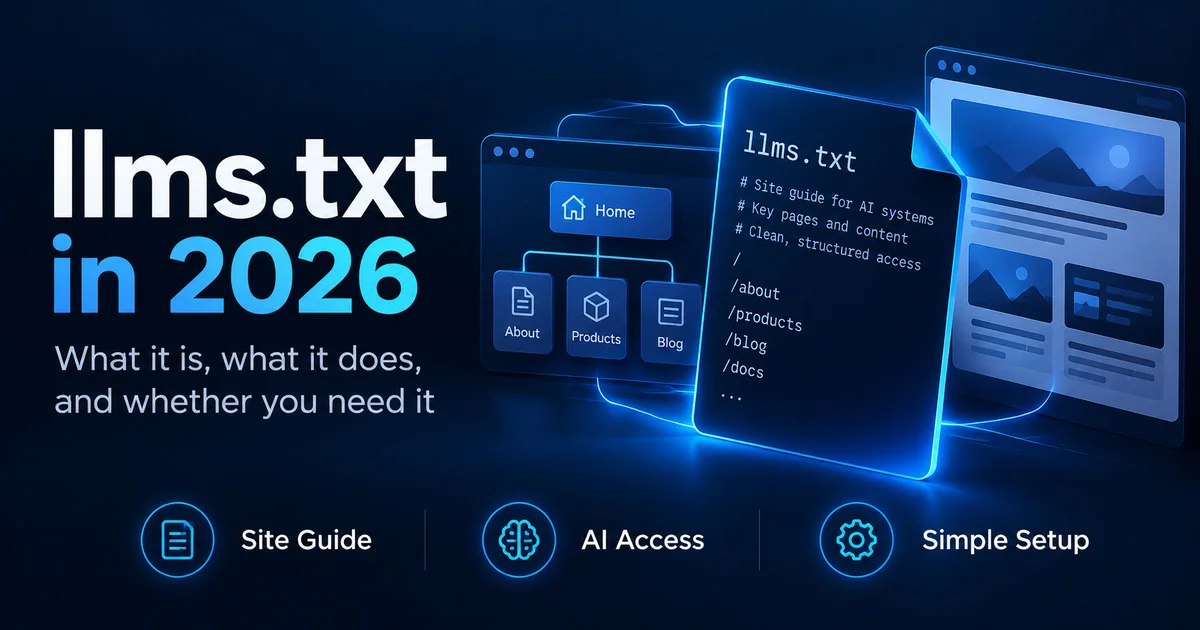
llms.txt is a proposed text file designed to give AI systems a curated, human-written map of a website's most important content. The idea is simple: place a file at /llms.txt and list the pages or resources you want an AI system to understand first.
The important part in 2026 is this: llms.txt is not a requirement for Google AI Overviews or AI Mode, and you should not treat it as a ranking shortcut.
It can still be useful as an experiment, documentation layer or machine-readable content map, but the fundamentals remain crawlability, indexing, internal links and useful content.
What llms.txt is trying to solve
Modern websites can be complicated.
They may include:
- Large navigation systems.
- JavaScript applications.
- Thousands of URLs.
- Old documentation.
- Duplicate parameter pages.
- Multiple products.
- Many content formats.
A curated text file can point a machine toward the pages that best explain the site.
A basic file might contain:
# Example Company

> Short description of what the company does.

## Core pages
- https://example.com/product/
- https://example.com/docs/
- https://example.com/pricing/

## Guides
- https://example.com/blog/main-guide/
The concept is easy to understand, which is one reason it has attracted attention.
What llms.txt is not
It is not:
- A replacement for robots.txt.
- A replacement for sitemap.xml.
- A Google ranking signal.
- A guaranteed way to get cited by ChatGPT.
- A special schema format.
- A permission system for AI training.
- A substitute for internal links.
Those distinctions matter.
llms.txt vs robots.txt vs sitemap.xml
| File | Main purpose |
|---|---|
robots.txt |
Controls crawler access to paths |
sitemap.xml |
Lists URLs you want search engines to discover |
llms.txt |
Proposed curated context for LLM-oriented discovery |
If you need to control a crawler, use the crawler's supported robots.txt directives.
If you want Google to discover your pages, use normal SEO discovery methods such as crawlable links and sitemaps.
If you want to experiment with a concise machine-readable map, llms.txt can be an additional layer.
What Google says
Google's official AI search documentation says you do not need new machine-readable AI files or special markup to appear in AI Overviews or AI Mode.
That is an important myth to remove.
See Google's AI features and your website guidance.
Google's systems still depend on normal Search eligibility, which means the page must be crawlable, indexed and eligible to appear with a snippet.
Why people are still testing llms.txt
Even without a Google requirement, there are reasonable reasons to test it.
1. It creates a curated machine-readable summary
You can choose the pages that best represent:
- Your product.
- Documentation.
- Research.
- Company.
- Important guides.
2. It forces you to define your information hierarchy
Writing the file can reveal whether your website has a clear structure.
If you cannot choose ten important URLs, your site architecture may be too scattered.
3. It can help internal tooling
Your own AI systems, crawlers or integrations can use the file as a starting point.
4. It is low cost when maintained carefully
A small text file is simple to publish.
The risk comes from treating it as more important than the website itself.
When llms.txt becomes harmful
The file can become a distraction if:
- It contains stale URLs.
- It contradicts your sitemap.
- It lists pages blocked in robots.txt.
- It points to low-quality content.
- You spend more time editing it than improving the actual site.
- You assume it gives permission to crawl content.
A machine-readable file is only as useful as the pages it references.
A good llms.txt structure
If you choose to use one, keep it concise.
Include
- Site name.
- One-sentence description.
- Main product or service pages.
- Key documentation.
- Important topic hubs.
- High-value evergreen guides.
- Contact or company information where useful.
Avoid
- Every URL on the website.
- Query parameters.
- Duplicate URLs.
- Temporary pages.
- Thin posts.
- Private areas.
- Pages you do not want crawled.
Your sitemap already handles comprehensive URL discovery. llms.txt should be curated.
Should a personal portfolio use llms.txt?
It can, but it should be small.
For aainulraza.online, a reasonable file can point to:
- Homepage.
- Blog.
- AI visibility guide.
- SaaS SEO guide.
- AI automation guide.
- Founder products.
- Contact information.
The site already has a public/llms.txt file, so the right strategy is to keep it aligned with the strongest content instead of trying to list everything.
How often should you update it?
Update it when the information architecture changes meaningfully.
Examples:
- A major new product launches.
- A new evergreen content hub becomes important.
- A key URL changes.
- A product is discontinued.
- Documentation moves.
Do not update the date or file just to create freshness signals.
How llms.txt fits into GEO
A strong GEO strategy includes:
- Search eligibility.
- Clear entities.
- Helpful content.
- Evidence.
- Internal links.
- Off-site corroboration.
- Measurement.
llms.txt can sit at the edge of that system as an optional discovery aid.
It is not the center.
What to prioritize before llms.txt
If you have one hour, do these first:
- Fix pages blocked from crawling accidentally.
- Check canonical tags.
- Improve internal links.
- Submit a valid sitemap.
- Strengthen page titles and descriptions.
- Make key content available as text.
- Add author and organization signals.
- Improve the article itself.
- Then review llms.txt.
This priority order is more likely to help both Google Search and AI retrieval.
What about AI training controls?
Do not use llms.txt as a training permission file unless a platform explicitly supports that interpretation.
Different AI companies may use different crawler names and policies.
Use supported mechanisms such as robots.txt where applicable, and check the current documentation for each crawler before making a decision.
My AI crawlers and robots.txt guide explains how to separate search retrieval, user-triggered fetching and training-related crawling.
How to test whether llms.txt is useful
Treat it like an experiment.
Record:
- Current AI citations.
- Current mentioned pages.
- Current crawl behavior if available.
- The pages listed in llms.txt.
Then check again after a meaningful period.
Do not expect one file change to create an immediate ranking jump.
A practical recommendation for 2026
Use llms.txt if:
- It is easy to maintain.
- You understand it is experimental.
- You want a curated machine-readable site summary.
- It supports your own tooling or documentation.
Do not use it as a substitute for:
- SEO.
- Sitemaps.
- robots.txt.
- Structured data.
- Original content.
- Authority.
How to maintain llms.txt as your site grows
If your site grows from twenty articles to sixty or more, resist the urge to turn llms.txt into a copy of your sitemap.
Keep the file curated around the pages that best explain the site.
A useful maintenance rule is to include:
- The main homepage.
- Core products or services.
- Major topic hubs.
- Evergreen guides that define the site's expertise.
- Documentation or research that is frequently referenced.
- A small number of trust pages when useful.
Then let sitemap.xml remain the comprehensive discovery file.
For a growing content site, this creates a useful separation:
sitemap.xml = all important indexable URLs
llms.txt = a curated orientation layer
If you automate llms.txt generation, make sure the output remains readable. An automatically generated file with hundreds of low-value links defeats the purpose of curation.
Should you list every blog post?
Not necessarily.
If every article is strong and the site is still small, listing all of them is reasonable. As the library grows, group links by topic or keep only the best evergreen resources.
For example:
- AI visibility.
- SaaS.
- SEO.
- Automation.
- CRM.
The structure should help a machine or developer understand the site quickly.
The same principle applies to humans: a good directory highlights what matters instead of dumping every URL without context.
Final takeaway
llms.txt is an interesting proposed standard, not a magic AI search file.
Publish it if it helps you organize and expose your most important resources, but keep expectations realistic.
If your site is hard to crawl, weakly linked or full of generic content, llms.txt will not solve the underlying problem. Build the useful website first. The text file comes after.
Co-Founder of Strat IQ Digital and builder of CrawlerQue and Stratly Digital, based in West Palm Beach, FL. I work on AI products, SaaS, SEO intelligence, CRM automation and growth systems.