Local SEO in the AI Search Era: A 2026 Guide for Service Businesses
Improve local visibility in Google Maps and AI search with stronger business profiles, reviews, service pages, local relevance and trust signals.

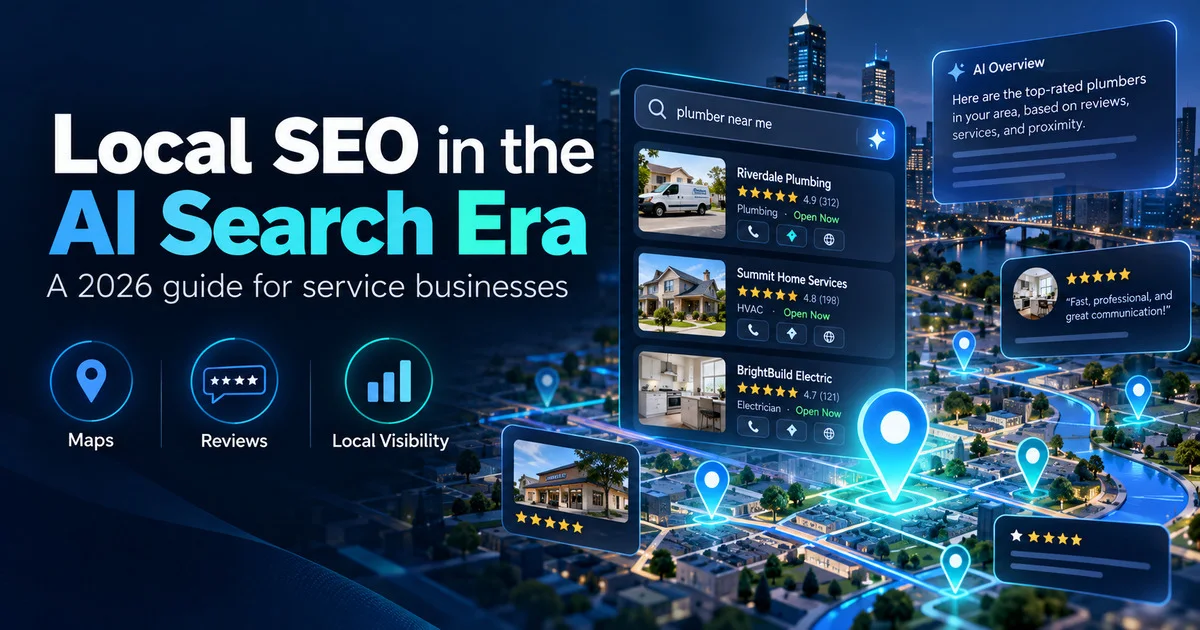
Local SEO in 2026 is no longer only about ranking a website for “service + city.” Customers can discover a business through Google Maps, local packs, AI-generated recommendations, voice-style questions and agentic search experiences that help users complete tasks.
The foundation is still simple: make the business information accurate, useful, trusted and easy to verify across the web.
For a local service business, the website and Google Business Profile should support each other rather than compete for attention.
How AI is changing local search
Traditional local search often looked like:
plumber near me
Modern queries can be much more specific:
Find a plumber near me who handles same-day water heater repairs, has strong recent reviews and is open Saturday morning.
AI search systems can interpret multiple constraints and combine:
- Business profile data.
- Website content.
- Reviews.
- Maps.
- Availability.
- Third-party sources.
This makes completeness and consistency more important.
The seven local SEO signals you can control
1. Google Business Profile completeness
Keep the profile accurate.
Check:
- Business name.
- Primary category.
- Secondary categories.
- Address or service area.
- Phone number.
- Website.
- Hours.
- Special hours.
- Services.
- Photos.
Do not add keywords to the business name unless they are part of the real-world name.
2. Review quality and recency
Reviews influence trust and conversion.
A healthy review profile has:
- Genuine customers.
- Recent feedback.
- Detailed comments.
- Owner responses.
- No incentive manipulation.
Do not buy reviews.
Instead, build a process that asks satisfied customers at a natural point after the service.
3. Strong service pages
A homepage cannot explain every service clearly.
Create dedicated pages for meaningful services when each page has real value.
For example:
- Roof repair.
- Roof replacement.
- Emergency leak repair.
- Commercial roofing.
Each page should explain:
- What the service includes.
- Who it is for.
- Common problems.
- Process.
- Service area.
- FAQs where useful.
- Contact path.
Avoid making dozens of thin pages with only the city name changed.
4. Location relevance
If you serve multiple cities, only create location pages when you can make them genuinely useful.
Good location content can include:
- Areas served.
- Local project examples.
- Service limitations.
- Local regulations where relevant.
- Travel or response expectations.
- Contact information.
A city page should help a local customer, not only repeat keywords.
5. Consistent business information
Keep name, address, phone and website details consistent across important profiles.
This can include:
- Google Business Profile.
- Bing Places.
- Apple Business Connect.
- Industry directories.
- Social profiles.
- Local associations.
Small punctuation differences are not the problem. Conflicting business identities are.
6. Useful local content
Local content can answer real questions such as:
- How much does a service usually cost in the area?
- Which permits are required?
- What weather conditions affect the service?
- How long does the work take?
- What should a customer prepare before the appointment?
This is stronger than generic “best company in city” content.
7. Website trust
Make it easy to verify the business.
Show:
- Contact information.
- Service areas.
- Business identity.
- Real photos.
- Policies.
- Licenses where relevant and accurate.
- Testimonials with permission.
- Clear pricing or pricing factors.
Optimize for AI local recommendations
AI systems need structured, consistent evidence.
Describe the business in plain language
Use sentences that answer:
- What do you do?
- Where do you operate?
- Who do you serve?
- What makes the service different?
- What constraints apply?
Avoid vague copy.
Keep structured data accurate
Local business structured data can help describe:
- Business name.
- Address.
- Phone.
- Hours.
- Website.
- Service type.
Only add information that is true and visible or verifiable.
Build service-specific evidence
If you want to appear for emergency plumbing, the website should clearly show that emergency plumbing is actually offered.
A generic list of twenty services in the footer is weaker than a well-developed service page.
Google Maps can become the destination
In many local journeys, the customer may never need the website.
They can:
- Read reviews.
- See photos.
- Check hours.
- Get directions.
- Call.
- Compare businesses.
That means profile optimization is not only an SEO task. It is a conversion task.
Search Engine Land has reported 2026 data showing changes in how users interact with local results as Maps becomes more central to the journey.
The website still matters because it supplies deeper evidence and helps convert users who need more confidence.
How to build a local topic cluster
For a service business, use three layers.
Core service pages
These target the main commercial needs.
Supporting guides
These answer research questions.
Location pages
These explain genuine geographic relevance.
Example:
Core: Website development for small businesses
Guide: How much does a small business website cost?
Guide: What pages should a local business website include?
Location: Website development in Islamabad
Only build the location layer when you can provide real local information.
Local SEO for businesses without a website
A Google Business Profile can create visibility, but a website provides assets you control.
A website gives you:
- More service detail.
- Better conversion paths.
- Original content.
- Structured data.
- Case studies.
- Forms.
- Analytics.
- A domain you own.
For agencies doing local outreach, this is an important point: the value of a website is not only “being online.” It is creating a trusted information source that search systems and customers can verify.
A monthly local SEO checklist
Google Business Profile
- Correct hours.
- Correct categories.
- New photos.
- Review responses.
- Service updates.
Website
- Broken links.
- Service page updates.
- Contact information.
- Mobile performance.
- Search Console issues.
Reputation
- New reviews.
- Directory accuracy.
- Brand mentions.
- Customer questions.
Performance
- Calls.
- Direction requests.
- Website visits.
- Leads.
- Branded searches.
- Local rankings where useful.
What not to do
Do not create hundreds of doorway pages
Pages made only to target nearby towns with duplicated text can create a poor user experience and may violate search spam policies.
Do not fake local addresses
Use real locations and legitimate service areas.
Do not buy reviews
Review manipulation can damage trust and platform standing.
Do not over-optimize the business name
Use the real business name.
How AI search changes the opportunity for small businesses
More conversational local search can be good for focused businesses.
A small company may be a strong match for a very specific request even if it is not the biggest brand in the city.
To benefit, make the evidence clear:
- Exact services.
- Exact area.
- Real reviews.
- Availability.
- Pricing factors.
- Credibility.
- Fast contact.
A practical local service page template
A strong service page can follow this structure:
Clear opening
State the service, location or service area and the main customer problem.
What the service includes
Explain the actual work instead of using marketing adjectives.
Who it is for
Describe the situations in which the service is appropriate.
Process
Show what happens after a customer contacts the business.
Pricing factors
If exact pricing varies, explain the variables that affect cost.
Service area
List genuine coverage areas.
Proof
Use real project examples, credentials, reviews or photos where permission allows.
Contact
Make the next step obvious.
This template gives both users and search systems enough context to understand the service without creating a thin location page.
Prepare for agentic local search
Google has been expanding agentic capabilities that can help users find and book local services.
That means local sites should make actions clear.
Check:
- Is the booking link obvious?
- Are opening hours current?
- Is the phone number clickable on mobile?
- Does the contact form have proper labels?
- Are service limitations explained?
- Is the location or service area unambiguous?
The more predictable the flow, the easier it is for humans and automated assistants to use.
Measure local outcomes, not only rankings
A number-one local ranking is useful only if it creates business value.
Track:
- Phone calls.
- Contact forms.
- Booking requests.
- Direction requests.
- Qualified leads.
- Revenue where possible.
Also watch branded search. If more users discover the company through AI-generated local recommendations, branded demand may rise even when website clicks do not increase at the same rate.
Final takeaway
Local SEO in 2026 is about being the easiest legitimate business to understand and verify.
Keep your Google Business Profile complete, publish strong service pages, earn genuine reviews, maintain consistent business information and make the website useful beyond keywords.
AI search adds another discovery layer, but it still depends on the quality of the underlying business information.
Co-Founder of Strat IQ Digital and builder of CrawlerQue and Stratly Digital, based in West Palm Beach, FL. I work on AI products, SaaS, SEO intelligence, CRM automation and growth systems.