How to Estimate the Real Cost of Building and Running a SaaS Product
Understand SaaS development, hosting, databases, authentication, AI APIs, security, maintenance and ongoing operating costs with practical examples.
Updated · Sources, examples and corrections
Many founders underestimate SaaS cost because they focus only on the initial build. In reality, the cost of a SaaS product includes not only design and development, but also hosting, databases, authentication, security, support and ongoing product improvement.
A product may be affordable to launch but expensive to run if usage grows, integrations multiply or the architecture is inefficient. Estimating the real cost early helps you price better, budget more accurately and avoid surprises.
The two big cost buckets
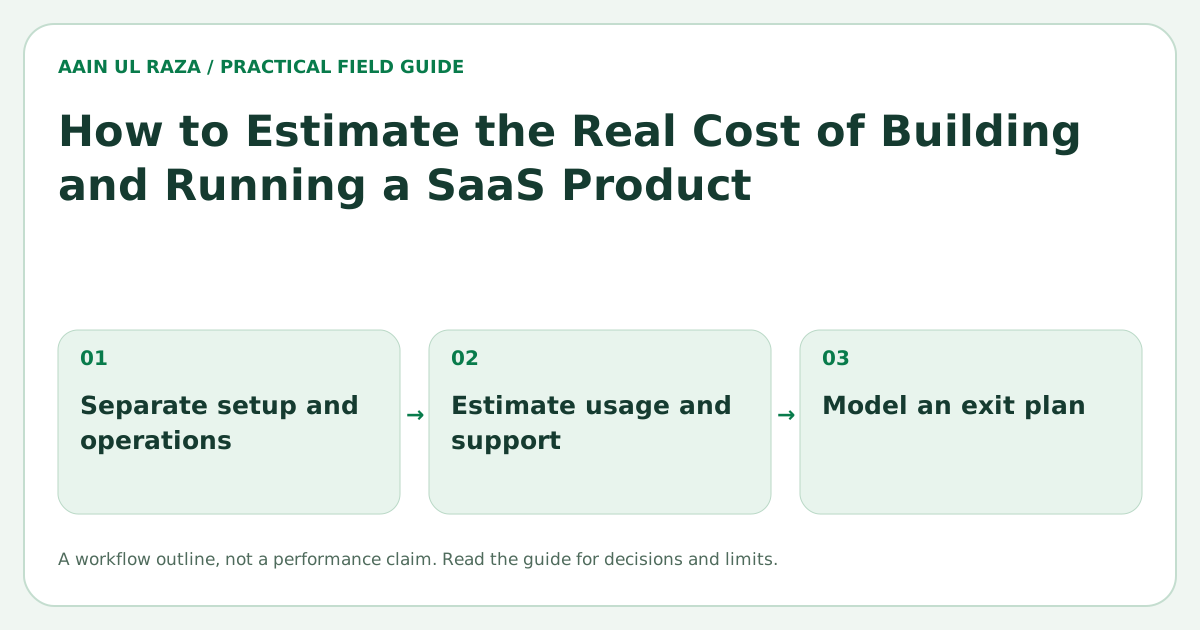
SaaS cost usually falls into two categories:
One time build cost
This includes product planning, design, development and initial launch.
Ongoing operating cost
This includes infrastructure, third party tools, APIs, security and maintenance after launch.
You need to understand both. Many products fail not because the build was too expensive, but because the monthly operating burden becomes too heavy.
One time build cost
1. Discovery and planning
This includes:
- Defining the problem
- Prioritizing MVP features
- Mapping user roles
- Designing workflows
- Choosing the stack
If this step is rushed, development cost usually increases later because the product has to be rebuilt or heavily changed.
2. UI and UX design
Design cost depends on whether you need:
- Basic wireframes
- Full visual design
- Design system components
- Mobile responsive screens
- Prototypes for testing
3. Front end and back end development
Development cost changes with complexity. A simple internal dashboard is very different from a true multi tenant SaaS with permissions, billing and APIs.
Typical feature areas include:
- Authentication and user accounts
- Team and role management
- Main product workflows
- Integrations
- Notifications
- Reporting
- Admin tools
4. Testing and launch
Do not ignore:
- QA testing
- Bug fixing
- Performance work
- Production deployment
- Analytics setup
- Documentation
Ongoing operating cost
Hosting and infrastructure
Common recurring infrastructure costs include:
- App hosting
- Background jobs or workers
- File storage
- CDN
- Monitoring
- Backups
Do not apply a generic monthly hosting range. Price the required compute, storage, jobs, bandwidth and support from current provider quotes at your expected usage.
Database
Database cost depends on:
- Number of records
- Query volume
- Read and write frequency
- Backup retention
- High availability requirements
A managed database is often worth it because it reduces maintenance risk.
Authentication and account management
You may pay for:
- Authentication provider
- Multi factor authentication
- Social login
- SSO for teams or enterprise customers
Basic auth costs may be modest at low usage, but they grow with active users.
AI APIs or external APIs
If your SaaS uses AI, map APIs, communication APIs or data providers, usage cost can be a major monthly line item. Common costs include:
- LLM prompts and completions
- Embeddings or vector search
- Speech or transcription APIs
- Email or SMS APIs
- Enrichment APIs
Variable usage costs should always be modeled at more than one volume level.
Security and compliance
Real SaaS cost includes:
- WAF or security tools
- Audit logging
- Access control
- Data retention controls
- Vulnerability patching
- Privacy and policy work
Security is often ignored until a product starts getting real customers. That is late.
Maintenance and support
Once customers start using the app, expect continuous cost for:
- Bug fixes
- Product support
- Feature requests
- Dependency updates
- Performance improvements
- Uptime monitoring
A founder should budget for maintenance from day one.
Practical monthly example
The following is a hypothetical USD planning budget for 300 active users, not a vendor quote or a market benchmark. Taxes are excluded; support and maintenance are explicit allowances.
| Cost area | Estimated monthly cost |
|---|---|
| Hosting and compute | $300 |
| Database | $150 |
| Storage and CDN | $80 |
| Authentication | $60 |
| Email and notifications | $40 |
| AI API usage | $400 |
| Monitoring and security | $120 |
| Support and maintenance | $600 |
| Total | $1,750 |
This does not mean every SaaS will cost that much. It shows how several moderate costs add up quickly.
Example build budget
The following hypothetical USD setup allowances illustrate cost categories. They are not typical market rates; obtain scoped quotes for the actual project:
| Build area | Example cost |
|---|---|
| Discovery and scoping | $1,000 to $3,000 |
| Design | $1,000 to $4,000 |
| Development | $8,000 to $30,000+ |
| QA and launch | $1,000 to $4,000 |
| Initial total | $11,000 to $41,000+ |
The range is wide because the product scope matters more than the category label.
What makes SaaS cost rise faster
Your cost climbs when you add:
- Multiple user roles and permissions
- Team collaboration
- Large data imports
- Complex reporting
- Many integrations
- AI heavy features
- Real time functionality
- Enterprise security requirements
Every one of these can be valuable, but each adds build and operating cost.
How to estimate cost more accurately
A practical founder workflow:
- Define the MVP clearly
- Split features into core, useful and later
- Model one time cost separately from monthly cost
- Estimate low, medium and high usage levels
- Add contingency for support and changes
- Recheck pricing before launch
Do not estimate using only a single number. Create scenarios.
Why pricing must connect to cost
If you do not understand your operating cost, pricing becomes guesswork. For example:
- If AI usage is heavy, low price plans may be unprofitable
- If support demand is high, self serve pricing may fail
- If database cost grows per customer, lifetime value must support it
A SaaS business needs healthy unit economics, not just a good product idea.
Model cost per active customer
Total monthly infrastructure cost is useful, but cost per active customer is more actionable. Divide the costs that scale with usage by the number of paying or active accounts. This helps you see whether gross margin improves or deteriorates as the product grows.
For example, if usage driven infrastructure, AI, email and support cost $2,000 per month for 400 active accounts, the variable operating cost is about $5 per account before fixed company expenses. If your average revenue per account is $39, there may be healthy room for support and growth. If average revenue is $8, the same system has a very different economic profile.
Build three usage scenarios
Every SaaS financial model should include at least three scenarios:
- Current or launch volume
- Expected growth volume
- Stress or high usage volume
For each scenario, estimate database size, API requests, AI usage, storage, bandwidth, support tickets and background jobs. This exposes pricing risks before customers create them.
Watch for cost cliffs
Some services scale smoothly. Others jump when you cross a plan limit. A database may require a larger compute tier. An authentication provider may become expensive above a user threshold. A third party API may have minimum commitments or expensive overages.
List these thresholds in your operating model. A cost cliff can reduce margin suddenly even when revenue is still growing.
Include the cost of reliability
Production software needs more than servers. Reliable SaaS also needs monitoring, backups, deployment discipline, error tracking and incident response. These costs may look optional during an MVP, but they become essential once customers depend on the product.
A strong budget includes time and tools for recovery, not just happy path operation.
Separate product work from maintenance work
As the product matures, development time splits into two categories. Product work creates new value. Maintenance work keeps existing value working.
Maintenance includes dependency updates, browser changes, API changes, security patches, bug fixes and infrastructure improvements. If you do not budget for maintenance, every new feature eventually becomes harder to deliver because technical debt consumes the team.
Use cost to improve product decisions
Cost modeling should influence feature design. If one AI feature costs $0.40 every time it runs and users trigger it 100 times per month, that feature alone creates $40 of variable cost per active user. That may be fine on a $199 plan and impossible on a $19 plan.
Before launching expensive features, estimate frequency, unit cost and the plan that will fund them. This connects product design to sustainable pricing.
Use your own financial projections
The SBA recommends explicit financial projections and supporting assumptions. Any sample infrastructure or operating costs shown here are scenarios, not live provider quotes or universal benchmarks. Replace them with dated contracts, usage estimates and staffing costs.
Stress-test one billable usage unit
For a fictional SaaS charging a flat $20 monthly fee, suppose an active account generates $4 of variable infrastructure and API cost plus $3 of support allocation. Contribution before fixed costs is $13. If a heavy user raises variable usage to $19 with the same support allocation, that account contributes minus $2 before fixed costs.
Model ordinary, high and abusive usage separately. Decide whether quotas, metering, fair-use rules or a different plan are necessary. Include billing-unit changes and minimum commitments in the scenario.
These assumed USD amounts are not vendor rates or a pricing recommendation. Use current quotes and observed usage. Averages can hide loss-making accounts, while a worst-case model without frequency can exaggerate the problem. Keep both unit economics and aggregate cash runway visible.
Further reference: SBA business-planning guide.
Frequently Asked Questions
What is the most overlooked SaaS cost?
Maintenance and support are often the most overlooked. Many founders budget for development but not for continuous improvement.
Should I use managed services or build more myself?
For most early stage SaaS products, managed services reduce complexity and risk, even if the raw monthly cost looks slightly higher.
How much of my budget should go to security?
There is no fixed percentage, but security should be part of the architecture from the start, not a late add on.
Do AI features make SaaS much more expensive?
They can. AI cost depends on request volume, prompt size, model choice and how often the feature runs.
Is a cheaper MVP always better?
Not necessarily. A very cheap MVP can become expensive later if the architecture is weak or the product is badly scoped.

Co-Founder of Strat IQ Digital and builder of CrawlerQue and Stratly Digital, based in West Palm Beach, FL. I work on AI products, SaaS, SEO intelligence, CRM automation and growth systems.