SaaS Onboarding Metrics: Activation, Time to Value and Retention Without Vanity Metrics
Build a practical SaaS onboarding measurement framework using activation events, time to value, cohort retention, onboarding completion and qualitative feedback.

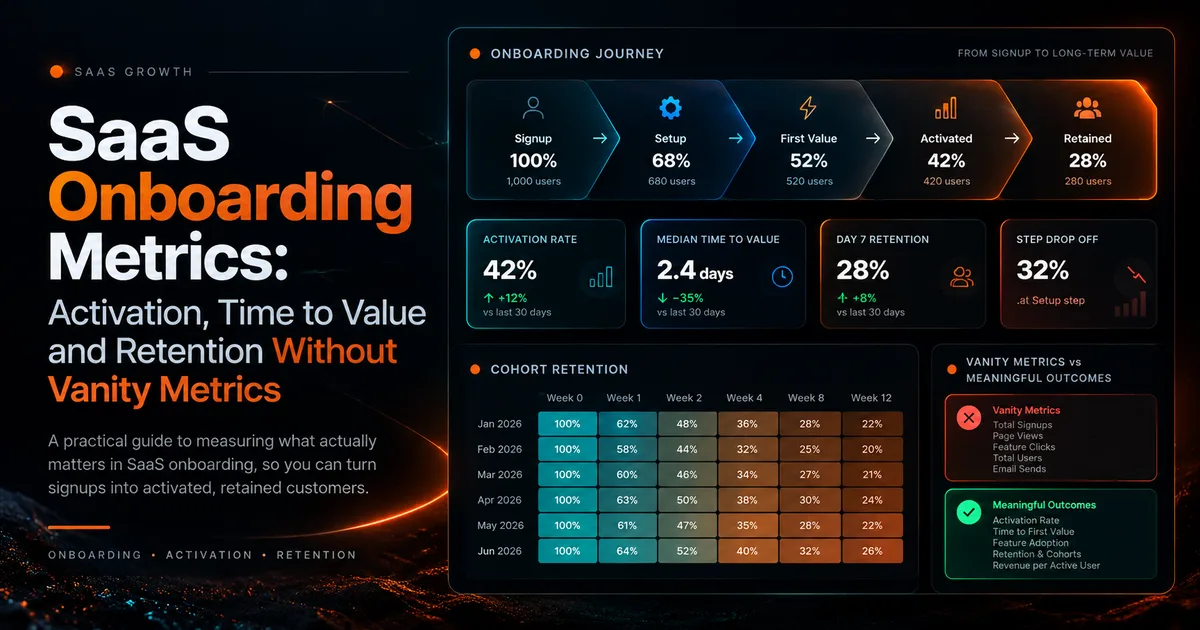
A signup is not the same as product adoption.
A user can create an account, complete onboarding and never receive value. That is why SaaS teams need metrics that describe the path from initial intent to a meaningful outcome.
The most useful onboarding measurement system begins with one question:
What action proves that a new user has experienced the core value of the product?
Define activation in product terms
Activation should describe meaningful product behavior, not simply account creation.
Examples:
- An SEO tool: completes the first crawl and opens the report.
- A CRM: imports or creates leads and completes the first follow up task.
- An analytics product: connects a data source and views a populated dashboard.
- A scheduling product: creates a booking link and receives the first booking.
The exact event should match the product promise.
Avoid activation by checklist completion
An onboarding checklist can be useful, but completing it is not automatically activation.
If a user checks five setup boxes without experiencing the product's main value, the metric rewards motion instead of outcome.
Use checklist completion as a diagnostic metric, not the final definition of success.
Measure time to value
Time to value is the elapsed time between a meaningful starting event and activation.
Possible start events:
- Account created.
- Email verified.
- Workspace created.
- First login.
Choose one and keep it consistent.
Then analyze the distribution rather than only the average. A few users who take weeks can distort the mean.
Useful views include:
- Median time to value.
- 25th and 75th percentiles.
- Percentage activated within one hour, one day and one week.
Build the onboarding funnel
A practical funnel might be:
- Signup
- Email verified
- Workspace created
- Data source connected
- First useful action completed
- Activation event reached
- Returned within seven days
Do not assume every user must follow exactly the same path. Segment by acquisition channel, plan or use case when the product supports multiple journeys.
Track failure points
For every onboarding step, measure:
- Entry count.
- Completion count.
- Drop off rate.
- Median time to next step.
- Error rate.
- Support requests associated with the step.
A step with high completion but unusually long time may still be a problem.
Cohort retention reveals whether activation was real
Group users by signup or activation period and measure whether they return to the core behavior.
For example:
- Week 0: activated users.
- Week 1: percentage performing the core action again.
- Week 4: percentage still active.
If users "activate" but disappear immediately, the activation definition may be too weak.
Segment by intent
A free trial user from an educational blog may behave differently from a user who searched for a high intent product comparison.
Useful segments include:
- Acquisition source.
- Company size.
- Role.
- Primary use case.
- Plan.
- Whether data import was required.
Do not create so many segments that every cohort becomes too small to interpret.
Use qualitative feedback beside analytics
Events explain what happened. They do not always explain why.
Collect lightweight qualitative signals:
- Exit question after failed onboarding.
- Support ticket themes.
- Short post activation survey.
- Sales notes for assisted accounts.
- Session review for repeated errors when privacy appropriate.
A repeated comment such as "I did not know what to connect" can explain a funnel drop faster than another dashboard.
Activation experiments
A good onboarding experiment changes one meaningful part of the path.
Examples:
- Replace a generic welcome screen with a use case choice.
- Preconfigure a sample project.
- Move optional profile fields after activation.
- Explain why an integration permission is needed.
- Show progress after a long running task.
Measure whether time to value and retained activation improve, not only button clicks.
Avoid vanity onboarding metrics
Metrics can look positive while hiding weak adoption.
Signups
Useful for demand, not proof of value.
Checklist completion
Useful for flow diagnostics, not necessarily activation.
Time in app
More time can mean engagement or confusion.
Number of clicks
More clicks can mean exploration or friction.
Tie the metric to the user's outcome.
Connect onboarding to product architecture
Long setup time may be a product problem rather than a copy problem.
Ask:
- Can defaults remove a decision?
- Can the product work before every integration is connected?
- Can sample data demonstrate value?
- Can an import run in the background?
- Can optional configuration wait until after activation?
A faster onboarding flow often comes from reducing required system state.
Build an activation dashboard
A useful dashboard can include:
| Metric | Why it matters |
|---|---|
| Signup to activation rate | Measures successful first value |
| Median time to value | Measures speed to outcome |
| Step drop off | Shows friction location |
| Day 7 retained activation | Tests whether value repeats |
| Support assisted activation | Reveals onboarding dependence |
| Activation by source | Connects acquisition quality to product use |
Keep the dashboard small enough that a team can act on it.
Connect acquisition and onboarding
Marketing promises shape onboarding expectations.
If an SEO landing page promises an instant audit but onboarding requires twenty minutes of configuration, the acquisition message and product experience are misaligned.
This is why product analytics and acquisition analytics should not be isolated.
For the product build process itself, see How to Build a SaaS MVP. For acquisition strategy, see SaaS SEO Strategy.
Final checklist
A useful SaaS onboarding measurement system should answer:
- What is the activation event?
- How long does activation take?
- Which step causes the most drop off?
- Which users activate fastest?
- Do activated users return to the core behavior?
- Which acquisition sources create retained users?
- What do failed users say was confusing?
- Which setup steps can be removed entirely?
The goal is not to make users finish onboarding. The goal is to help them reach value quickly enough that they want to return.
Co-Founder of Strat IQ Digital and builder of CrawlerQue and Stratly Digital, based in West Palm Beach, FL. I work on AI products, SaaS, SEO intelligence, CRM automation and growth systems.