Zero-Click Search Strategy in 2026: How to Win Visibility When Users Do Not Click
Learn how to adapt SEO for zero-click search in 2026 with stronger brand visibility, citations, conversion paths and content designed for AI search.

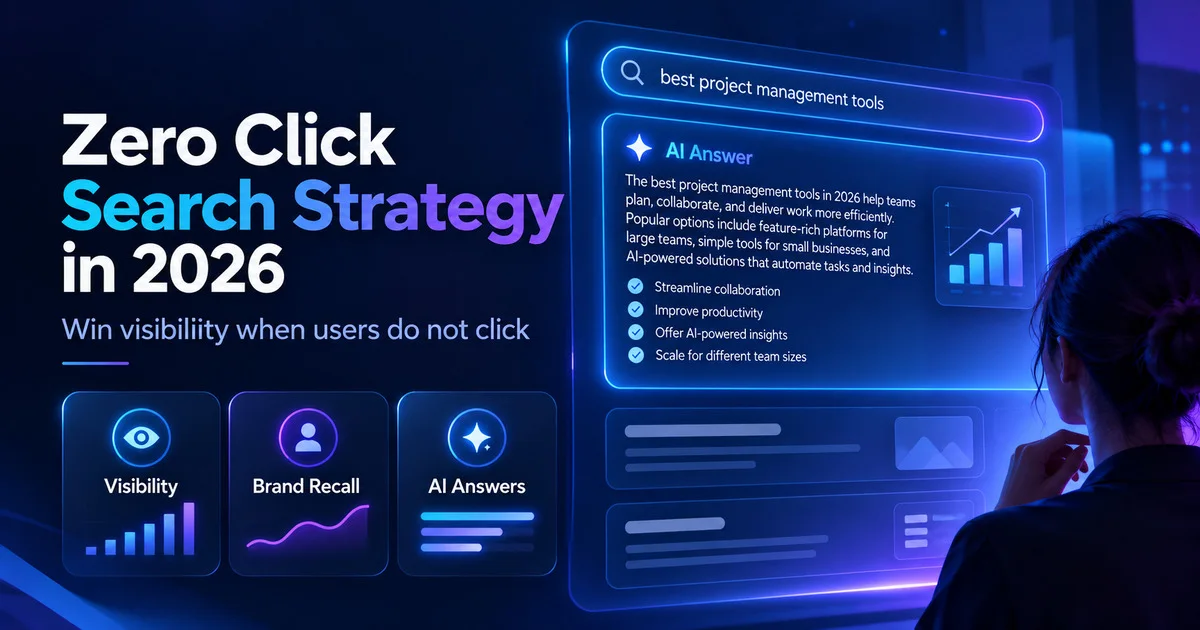
A zero-click search is a search session where the user gets enough information from the search experience that they do not immediately visit a traditional organic result. In 2026, zero-click behavior matters more because AI Overviews, AI Mode, maps, featured results and other search features can answer more questions directly.
The wrong response is to give up on SEO. The better response is to change what you measure and what your content is designed to accomplish.
Your page may now create value in four ways: earn a click, earn a citation, build brand familiarity or influence a later conversion.
Why zero-click search is growing
Search engines have steadily added richer result formats for years. AI search accelerates that pattern because a single response can combine information from several sources.
Industry research in 2026 has reported significant click-through-rate pressure when AI Overviews appear. At the same time, Google says its AI search experiences are creating new kinds of queries and opportunities for websites to be discovered.
Both can be true.
Users may click less often on simple information queries while still clicking when they need:
- A deeper explanation.
- A tool.
- Original data.
- A comparison.
- A product.
- A first-hand perspective.
- A service provider.
- A source they trust enough to verify.
This changes content strategy.
Stop treating every impression as a failed click
A classic SEO dashboard often looks like:
Impressions → clicks → conversions
In zero-click search, add two more outcomes:
Impressions → citations → brand recognition → later visits
That means you should monitor:
- Search impressions.
- Click-through rate.
- Branded query growth.
- AI citations.
- Direct traffic.
- Referral traffic from AI assistants.
- Return visits.
- Conversions from branded searches.
The goal is not to explain away traffic losses. It is to understand the full discovery path.
Which queries are most vulnerable to zero-click behavior?
Simple informational queries are usually more exposed.
Examples:
- Definitions.
- Short calculations.
- Basic facts.
- Simple comparisons.
- Quick instructions.
If a user can get the complete answer in two sentences, an AI result may satisfy the need without a visit.
More defensible content tends to involve:
- Original tools.
- Templates.
- Calculators.
- Detailed examples.
- Unique datasets.
- Interactive experiences.
- First-hand testing.
- Strong opinions backed by evidence.
- Complex workflows.
- Decision support.
For a site like aainulraza.online, that means articles should not exist only to restate generic definitions. They should help a reader do something.
A seven-part zero-click search strategy
1. Target questions where the click has a reason to exist
Before writing, ask:
What will the reader get on my page that cannot fit comfortably inside a short AI summary?
Good answers include:
- A step-by-step implementation process.
- A downloadable framework.
- A diagnostic checklist.
- A comparison table.
- Screenshots.
- A live tool.
- A detailed decision model.
- Original research.
If you cannot answer that question, the topic may still be useful for brand coverage, but you should not expect high click volume.
2. Make the first answer extractable
This sounds contradictory, but it is important.
You want the page to be easy for search systems to understand and cite. Put a concise answer near the beginning, then make the rest of the page worth visiting.
A good pattern is:
Direct answer → explanation → evidence → workflow → example → next action
This supports both AI retrieval and human usefulness.
3. Create information gain
Information gain means your page contributes something new compared with what a user can already find.
That can be:
- A unique framework.
- A better classification.
- A first-hand observation.
- A clearer comparison.
- Original examples.
- A useful synthesis of primary documentation.
- A tested workflow.
I explain this in more detail in Information Gain SEO: How to Create Content Worth Citing.
4. Build brand memory into useful content
Do not stuff your brand name into every paragraph. Instead, attach your brand to a genuinely useful concept.
For example, if you publish a clear framework for evaluating AI visibility, readers may remember the framework and the author together.
Useful brand signals include:
- Consistent author bylines.
- A clear author page or profile.
- Product examples that are relevant to the article.
- Original diagrams.
- Named frameworks.
- Consistent topical expertise.
This is one reason GEO and AI visibility should be treated as an entity and content strategy, not just a keyword strategy.
5. Strengthen the conversion path for the clicks you still earn
If clicks are harder to win, each click matters more.
Check whether your important pages have:
- A clear next step.
- Relevant internal links.
- A fast mobile experience.
- An obvious author and source.
- No distracting overlays.
- A useful CTA that matches the article intent.
A reader who arrives from an AI citation may be highly informed already. Do not force them back through a generic marketing funnel.
6. Measure visibility outside classic organic clicks
Create a monthly report with:
| Metric | Why it matters |
|---|---|
| Organic impressions | Shows search exposure |
| CTR | Shows click capture |
| Branded queries | Shows demand creation |
| AI citations | Shows source visibility |
| Direct traffic | Can indicate brand recall |
| AI referrals | Captures measurable assistant traffic |
| Leads and trials | Shows business outcome |
For a deeper measurement model, use the AI Search ROI guide.
7. Build multiple discovery surfaces
Do not rely on one result type.
A modern discovery strategy can include:
- Google organic search.
- AI Overviews and AI Mode.
- Image and multimodal search.
- YouTube or short-form video.
- LinkedIn.
- Relevant communities.
- Product directories.
- Founder profiles.
Google has been expanding ways for users to find original sources and creator perspectives across Search. Your website should remain the authoritative home, but your reputation should not exist only on your own domain.
How to write content for a zero-click world
Lead with a useful answer
Do not hide the answer behind a long introduction.
Add layers that an AI summary cannot fully replace
For example:
- “What is AI visibility?” can be answered quickly.
- “How do I build a 50-prompt AI visibility benchmark for a B2B SaaS product?” requires a process.
The second query gives the website more room to add value.
Use tables for decisions, not decoration
Tables work well when the reader is comparing:
- Options.
- Metrics.
- Stages.
- Costs.
- Trade-offs.
- Tools.
- Risks.
Use examples from real workflows
You do not need a dramatic case study. A realistic workflow is often enough.
For example, when evaluating an AI visibility product, a founder can compare prompt coverage, citation tracking, competitor detection and reporting. That is more useful than a generic “AI is changing SEO” paragraph.
Should you block AI features because they reduce clicks?
That is a business decision, not a universal SEO rule.
Google provides controls for how content can appear in Search previews and has added more controls around generative search. But opting out can also reduce discovery.
Before changing crawl or preview controls, measure:
- How much visibility you receive.
- Whether that visibility creates branded demand.
- Whether AI referrals convert.
- Whether your content is being reused in a way you are comfortable with.
Do not make the decision from fear alone.
Zero-click does not mean zero value
A search can end without a click and still influence a purchase.
Think about how people choose software. They may:
- Ask an AI assistant for options.
- See your brand.
- Search your brand later.
- Read a review.
- Visit your site directly.
- Start a trial.
The first interaction may never show up as a referral, but it still mattered.
This is why brand-building and search are becoming more connected.
Common mistakes
Chasing only high-volume informational keywords
These can produce impressions while generating weak commercial value.
Removing useful answers to force clicks
If your page is intentionally vague, it is less useful to both humans and search systems.
Publishing dozens of near-identical articles
Google's people-first guidance warns against creating large amounts of content primarily to attract search traffic. Build a focused topic system instead.
Judging success only by CTR
CTR matters, but it is no longer the whole discovery picture.
A practical 2026 playbook
For every important topic:
- Identify the real user task.
- Write the direct answer.
- Add unique value beyond the answer.
- Link to deeper supporting content.
- Make the author and brand clear.
- Add a relevant conversion path.
- Track citations, branded demand and conversions.
Google's official guidance for AI search continues to emphasize helpful, reliable content, crawlability, internal links, good page experience and text that users can access. There is no special shortcut for AI features. See Google's guidance for AI features.
Final takeaway
Zero-click search changes the economics of SEO, but it does not make websites irrelevant.
The sites that remain valuable are the ones that provide something worth visiting: original evidence, useful tools, better decisions, deeper explanations and credible expertise.
Optimize for the answer, but build the page for the next question. That is how you stay useful when the search result itself can answer more than before.
Co-Founder of Strat IQ Digital and builder of CrawlerQue and Stratly Digital, based in West Palm Beach, FL. I work on AI products, SaaS, SEO intelligence, CRM automation and growth systems.