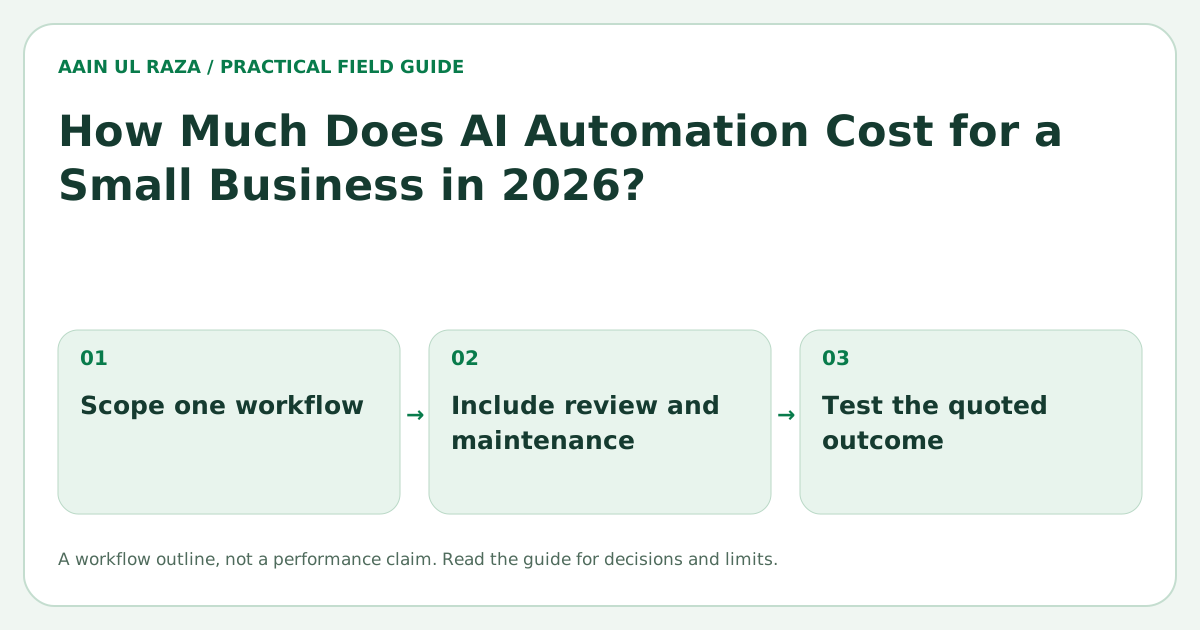
How Much Does AI Automation Cost for a Small Business in 2026?
Build an AI automation budget with scoped costs, hypothetical USD examples, token calculations, review time and a practical supplier acceptance test.
Updated · Sources, examples and corrections
AI automation has no single small-business price. Estimate a specific workflow: its volume, integrations, review effort and cost of failure. A subscription price alone is not an implementation budget.
This guide builds a quote worksheet and three hypothetical USD budgets. They are planning examples, not market averages, supplier quotes or results from a client. Taxes and currency conversion are excluded. Replace every input with your own invoice, quote or observation before deciding.
Define the workflow before asking for a quote
Write a one-paragraph scope. For example: "Collect website enquiries, check required fields, draft a qualification summary, create or update one CRM record, and ask an employee to approve the next action."
Specify what does not happen. In this example, the automation cannot reject a customer, approve a discount or send a binding proposal. Those boundaries change the integration and testing work substantially.
A usable brief records:
- Monthly tasks and the largest expected hourly burst.
- Input systems, output systems and required paid seats.
- Personal data involved and who can access it.
- What a successful task looks like.
- What happens when the model or an API fails.
- Who maintains the workflow after delivery.
Use the CRM workflow checklist to record these decisions.
Separate five cost lines
| Cost line | What to include | Evidence to request |
|---|---|---|
| Implementation | Mapping, integration, tests, training, migration | Deliverables and acceptance criteria |
| Recurring software | Seats, automation tasks, CRM add-ons | Plan, billing interval and usage allowance |
| Usage | Model tokens, calls, messages, storage | Unit rates and expected monthly volume |
| Human operation | Review, exceptions, corrections | Sampled minutes per task and loaded labor rate |
| Maintenance | Monitoring, prompt changes, vendor changes | Named owner, response time and included hours |
A cheaper setup can become expensive if every exception needs the developer. Request a documented handoff and a way to disable writes without losing incoming work.
Three illustrative monthly budgets
Each scenario assumes one workflow operating at the stated volume. The software amount is a placeholder allowance, not a current vendor plan price. Implementation is shown separately and is not included in monthly totals.
| Assumption, USD | Lead summary pilot | Reviewed CRM workflow | Support triage workflow |
|---|---|---|---|
| Tasks per month | 500 | 1,500 | 3,000 |
| Software allowance | $50 | $120 | $180 |
| Usage allowance | $8 | $38 | $63 |
| Human review allowance | $60 | $180 | $240 |
| Maintenance allowance | $40 | $120 | $120 |
| Monthly total | $158 | $458 | $603 |
| One-time setup assumption | $600 | $2,400 | $3,600 |
These budgets omit new hardware, major data cleanup, legal review and custom security assessments. A second integration or a strict support SLA could change the scope. Ask whether annual billing, minimum commitments, overages and refunds affect the quote.
Estimate model usage without confusing it with total cost
For a token-priced model, calculate input and output separately:
Input cost = runs × input tokens per run ÷ 1,000,000 × input rate
Output cost = runs × output tokens per run ÷ 1,000,000 × output rate
Hypothetical example: 1,000 runs, 1,500 input tokens and 250 output tokens per run, with assumed rates of $1 and $5 per million respectively:
- Input: 1,000 × 1,500 ÷ 1,000,000 × $1 = $1.50.
- Output: 1,000 × 250 ÷ 1,000,000 × $5 = $1.25.
- Token subtotal: $2.75.
This is not the price of the workflow. Add retries, retrieval, tool calls, messaging, storage and human review where applicable. Recheck the official OpenAI API pricing for the model and billing mode you actually choose. The assumed rates above deliberately do not identify a live model.
For automation platforms, inspect the unit being sold. The Zapier pricing page and n8n pricing page help identify their current billing units; a task and a workflow execution should not be assumed equivalent.
Separate staff capacity from cash savings
Treat a proposal's ROI figure as a calculation to reconstruct. Ask for volume, manual handling time, expected automation coverage, review time, recurring costs and setup cost separately. A picture of an upward chart is not evidence that any of those inputs match your business.
For a reproducible planning example, suppose there are 600 monthly tasks at four manual minutes each. That is 40 hours of current handling. Removing 75% releases 30 hours before review. Five review hours leave 25 hours. At an assumed loaded rate of 20 per hour, the remaining capacity value is 500. Subtract recurring software and maintenance of 170 to obtain 330, then allocate setup of 1,200 over 12 months to obtain 230 per month of modeled economic value.
These inputs are hypothetical. The calculation does not mean payroll falls by 230 or that a vendor will deliver the assumed coverage. It excludes error losses, financing and taxes. If the 25 released hours cannot be productively reassigned, their economic value may be lower than the salary-rate multiplication suggests.
Run a sensitivity check before buying. If review doubles from five to ten hours, capacity value falls by another 100 under the same assumptions. If monthly task volume falls by half but the software charge stays fixed, the unit economics change again. Agree which quantity the pilot will measure and what result would cause you to stop.
Use the existing automation ROI planner to separate capacity and cash assumptions, then test the quoted workflow on synthetic inputs with missing fields, duplicate submissions and a failed downstream service. The supplier should demonstrate the recovery path and the person responsible for an exception. A successful perfect-input demo does not measure maintenance cost or prove sustained savings.
Test the quote with a small acceptance batch
Before a larger rollout, prepare synthetic examples covering a normal enquiry, duplicate submission, missing email, very long message, unavailable CRM and a misleading instruction inside the input.
For each example, agree the expected record, permitted action, review requirement and recovery route. The supplier should show that retrying a request does not create a second CRM record. A demonstration on one perfect enquiry does not establish reliability.
Keep a simple acceptance record: test ID, input class, expected result, observed result, reviewer, open issue. Pay for a defined outcome such as an approved pilot and handoff, rather than an undefined promise to "add AI."
What to do next
Choose one frequent, reversible workflow. Measure its current time and error rate, obtain scoped quotes and compare total operating cost over the same period. Expand only when the pilot has a named owner and an affordable exception path.
Does a low API bill mean automation is inexpensive?
It can mean model usage is inexpensive at your volume. Integration, review and maintenance may still dominate the total.
Should a business build or buy?
Buy when a supported product meets the workflow and control requirements. Consider custom work when the missing behavior has a clear business value that covers ongoing ownership. Compare both over the same horizon, including migration and exit costs.

Co-Founder of Strat IQ Digital and builder of CrawlerQue and Stratly Digital, based in West Palm Beach, FL. I work on AI products, SaaS, SEO intelligence, CRM automation and growth systems.