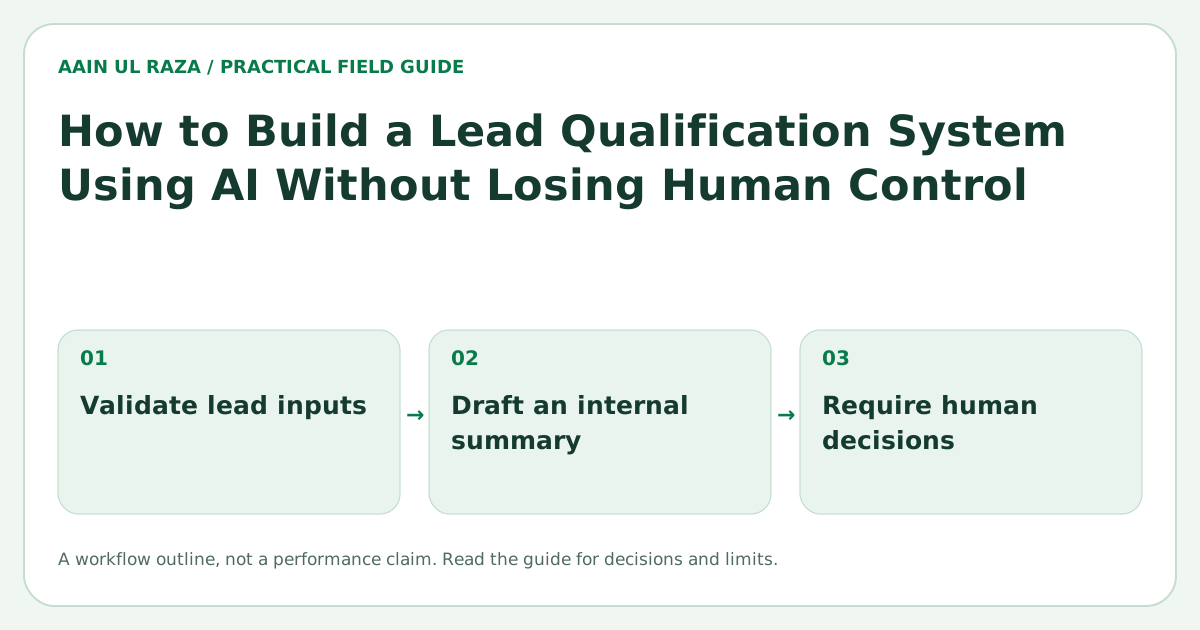
How to Build a Lead Qualification System Using AI Without Losing Human Control
Learn how to automate lead scoring, qualification and CRM workflows with AI while keeping human approval, data quality and practical oversight.
Updated · Sources, examples and corrections
AI can help businesses sort incoming leads faster, identify buying signals and move good opportunities to the right salesperson, but fully automated qualification can create problems if nobody checks the output. The real goal is not to remove humans. The goal is to let AI handle the repetitive analysis while people stay in control of important decisions.
A good lead qualification system uses AI to speed up review, enrich data and score fit, but it also keeps clear approval rules, audit history and fallback logic.
What AI can do in lead qualification
AI is useful for tasks such as:
- Reading form submissions
- Summarizing inquiry text
- Detecting intent or urgency
- Classifying company type or service interest
- Scoring lead fit based on rules
- Recommending the next action
For example, if a lead submits a request saying they need a CRM for a five person team and want implementation help this month, AI can classify the intent as high, assign a likely service type, and suggest that the lead should be routed to sales quickly.
What humans should still control
Even strong automation needs human oversight in areas such as:
- Final approval for high value leads
- Pricing or proposal decisions
- Exceptions and ambiguous cases
- Changes to scoring rules
- Validation of lead ownership and assignment
If the workflow affects revenue or customer experience, do not treat AI output as unquestionable truth.
The ideal workflow structure
A practical AI lead qualification system usually has five stages.
1. Capture incoming leads
Collect leads from:
- Website forms
- Landing pages
- Ads
- Chat widgets
- Email inquiries
- Imported lists
At this stage, make sure the form structure is clean. If the input data is messy, the AI output will also be weak.
2. Enrich and clean the data
Before scoring, enrich the lead with useful context such as:
- Company size
- Industry
- Location
- Service interest
- Traffic source or campaign
- Previous interaction history
Some enrichment can be automated through integrations or enrichment providers. Some can come from your own CRM records.
3. Use AI to score and classify
AI can review the lead and produce outputs like:
- High fit
- Medium fit
- Needs nurture
- Low fit
It can also provide a short explanation, such as:
High fit because the lead has clear commercial intent, team budget, immediate timeline and requested implementation support.
This explanation is important. A score without a reason is much less useful.
4. Apply human approval rules
Not every lead needs the same level of review. A practical rule set might look like this:
- Score above 85 and clear buying intent: auto assign to sales
- Score between 50 and 85: manager review or nurture assignment
- Score below 50: keep in nurture or archive after review
- Missing key data: manual review required
This creates speed without blind automation.
5. Push the result into the CRM workflow
After review, the system can:
- Create or update the lead
- Assign an owner
- Trigger a follow up task
- Start an email sequence
- Add tags or lifecycle stages
- Send an alert to a rep or manager
Designing your lead scoring model
A strong scoring model blends rules and AI context.
Examples of positive signals
- Clear request for demo or quote
- Short buying timeline
- Strong company fit
- Relevant use case
- Budget or urgency indicators
- Decision maker or owner inquiry
Examples of weaker signals
- Student research inquiry
- Vendor partnership request
- No clear business need
- Long term interest with no timeline
- Poor fit industry or region
Keep the model transparent
Do not let the system become a black box. Document what influences the score. This makes it easier to trust, audit and improve.
How to avoid common AI qualification mistakes
Mistake 1: No human review for ambiguous leads
Some leads look weak in text but are valuable in reality. Ambiguous or incomplete inquiries should be routed for review, not silently rejected.
Mistake 2: No confidence threshold
If the AI is uncertain, the workflow should escalate to a person.
Mistake 3: Bad CRM data
If the CRM already contains duplicates or bad ownership, automation will amplify those problems.
Mistake 4: No feedback loop
Sales should be able to mark whether AI qualification was correct. That feedback should improve future scoring.
Metrics to track
A lead qualification system should be measured with more than speed alone. Track:
- Lead to opportunity rate
- Response time
- Sales acceptance rate
- False positives
- False negatives
- Time saved per rep
- Number of manual adjustments
If the system is fast but sends bad leads to sales, it is not working.
Example system for a small business
A simple version may work like this:
- Website form creates lead record
- AI summarizes the inquiry and scores fit
- Leads above 80 go to the sales queue
- Leads from 50 to 79 go to a manager review board
- Leads below 50 enter nurture unless marked irrelevant
- CRM creates tasks and alerts automatically
- Sales team gives feedback on quality weekly
This type of system is realistic, controlled and much easier to maintain than a fully automated black box.
Why human control improves results
Human control is not a weakness. It makes the system more reliable because:
- Edge cases get reviewed
- Bad leads are not pushed too far
- Good leads are less likely to be missed
- Managers can spot pattern problems early
- Trust in the system increases across the team
In practice, the best AI workflows are not the ones that remove people. They are the ones that help people make faster, better decisions.
Design the scoring model with evidence
Do not begin by asking an AI model to "score this lead from 1 to 100" with no structure. Start with evidence your sales team already trusts. Look at recently won and lost opportunities and identify the signals that actually separated good leads from weak ones.
Useful signals may include company size, service fit, buying timeline, geography, budget range, decision authority and the specificity of the request. Assign clear weights or categories to these signals, then let AI interpret unstructured text inside that framework.
This hybrid approach is easier to audit because the system can explain not only the score, but the evidence behind it.
Separate fit, intent and urgency
One score can hide important differences. A better model often evaluates three dimensions:
Fit asks whether the lead matches the type of customer you serve well.
Intent asks whether the person is demonstrating real buying behavior.
Urgency asks whether the need has a near term timeline.
A perfect fit with low intent may need nurture. A medium fit with very high urgency may deserve fast human review. Separating the dimensions produces more useful decisions than a single opaque number.
Create an exception queue
Every good automation needs somewhere to put uncertain cases. Build an exception queue for leads with missing fields, contradictory information, low model confidence or unusually high potential value.
The queue should show the original lead details, AI recommendation, confidence or reason, and buttons for approve, adjust or reject. Human decisions should be stored as feedback so you can see where the system was wrong.
Protect against data drift
Lead quality patterns change when your marketing channels, offers or target market change. A scoring model built on last quarter's leads may become less accurate after a major campaign change.
Track approval rates and outcome rates by source. If leads from one source are consistently being overridden by managers, investigate why. The answer may be a bad rule, a new audience or missing context.
Keep sales accountable too
AI qualification should not become a way for sales teams to ignore follow up discipline. Track what happens after qualified leads are routed. Useful measures include first response time, number of contact attempts, opportunity creation rate and final outcome.
If AI sends strong leads but reps respond two days later, the problem is not the qualification model. The workflow has to connect qualification quality with execution quality.
Keep missing evidence out of the score
In a proposed agency qualification flow, a lead that omits its budget has an unknown budget, not a zero budget. Separate known facts, inferred suggestions and missing fields in the review record.
| Field state | Example | Permitted use |
|---|---|---|
| Explicit fact | Prospect selected a service | Apply the documented fit rule |
| Missing | No budget supplied | Ask or queue for review |
| Model inference | Message sounds urgent | Show a suggestion with supporting text |
| Contradiction | Two different company names | Require correction before routing |
Test whether changing a person's name while keeping business facts identical changes the suggested score. Unexpected differences need investigation before operational use. Keep a human route for appeals and corrections. The NIST AI RMF is a governance reference, not evidence that a score is fair or accurate.
Frequently Asked Questions
Should AI automatically reject low score leads?
Usually no. Low score leads should often stay in a nurture or review bucket unless they are clearly irrelevant or spam.
What is a good lead score threshold?
There is no universal number. Thresholds should be based on your lead quality patterns, sales capacity and tolerance for review.
Can small businesses use AI lead scoring without a big CRM stack?
Yes. Even a basic CRM plus one automation tool and clear scoring rules can support a useful lead qualification workflow.
How often should I review the scoring model?
Monthly reviews are helpful at the start. Later, quarterly updates may be enough if the workflow is stable.
What is the biggest success factor?
Clean input data and a clear handoff between AI output and human review are usually the biggest success factors.

Co-Founder of Strat IQ Digital and builder of CrawlerQue and Stratly Digital, based in West Palm Beach, FL. I work on AI products, SaaS, SEO intelligence, CRM automation and growth systems.