ChatGPT SEO in 2026: How to Improve Brand Visibility and Recommendations
Improve brand visibility in ChatGPT and other AI assistants using entity clarity, credible sources, useful content and repeatable prompt tracking.

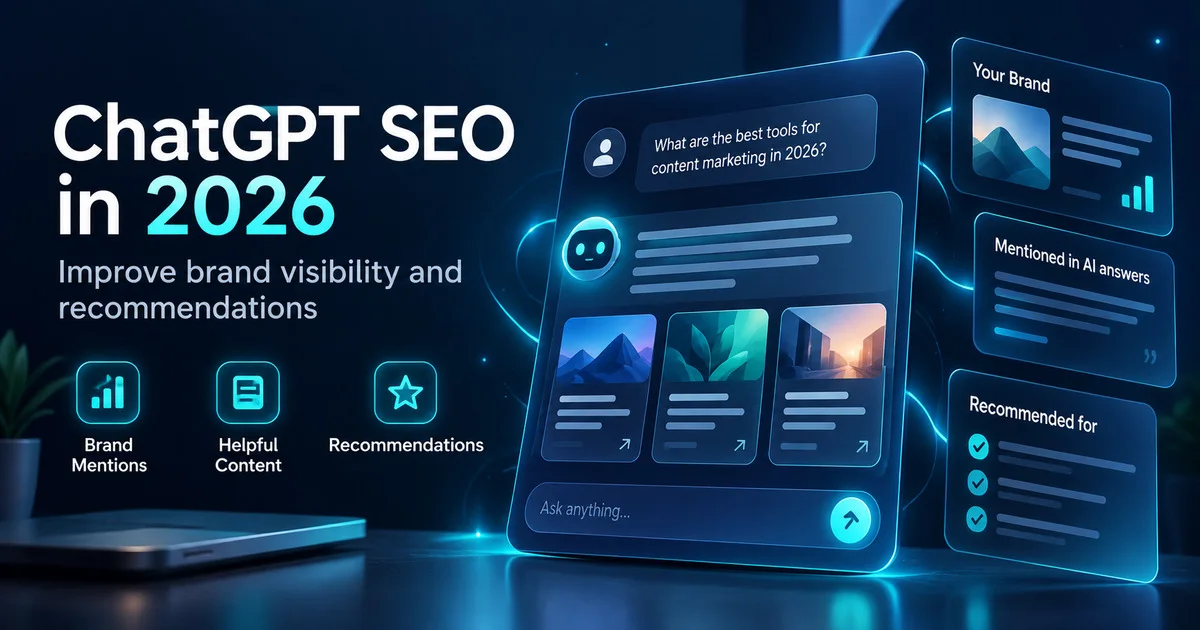
“ChatGPT SEO” is an informal term for improving how easily your brand, products and content can be discovered and represented in ChatGPT experiences that use web search or retrieved sources. It is not a separate official ranking system with a guaranteed checklist.
The practical work looks familiar: build a clear entity, publish useful content, earn credible mentions, keep important pages crawlable and measure how the brand appears across realistic prompts.
The biggest mistake is trying to optimize for one model response instead of improving the web evidence the model can retrieve.
How ChatGPT visibility differs from Google rankings
Google Search has a relatively visible ranking interface.
You can see:
- Queries.
- Positions.
- Impressions.
- Clicks.
- Indexed URLs.
AI assistants are more variable.
A response can depend on:
- Prompt wording.
- Conversation context.
- Whether web search is used.
- Geography.
- Model version.
- Current web sources.
- User preferences.
- The exact sub-questions the system generates.
That means you should measure patterns, not one answer.
What makes a brand easier to recommend?
An AI assistant needs enough reliable information to answer questions such as:
- What does this company do?
- Who is it for?
- What makes it different?
- Is the product active?
- Is the brand recognized outside its own website?
- Are claims supported?
- Does the product fit the user's constraints?
Your optimization work should make those answers easier to verify.
1. Build a clear entity
Use the same core facts consistently across the web.
For a company:
- Official name.
- Website.
- Product category.
- Short description.
- Founder or leadership.
- Contact information.
- Social profiles.
For a person:
- Full name.
- Role.
- Company.
- Products.
- Areas of expertise.
- Official profiles.
Avoid changing the way you describe the business on every platform.
Consistency helps reduce ambiguity.
2. Publish pages that answer buyer questions
Do not only publish company news.
Create useful pages for questions buyers actually ask:
- Best way to solve a problem.
- How to compare options.
- Which features matter.
- Common implementation mistakes.
- Pricing trade-offs.
- Migration steps.
- Integrations.
- Alternatives.
- Use cases.
If an assistant is answering a recommendation prompt, it needs evidence that your product fits the requested use case.
3. Make product claims specific
Weak:
“Our platform uses advanced AI to transform your business.”
Better:
“The platform audits a domain, identifies SEO issues, evaluates AI visibility and organizes findings into a report.”
Specific claims are easier to evaluate.
Use:
- Feature pages.
- Documentation.
- Screenshots.
- Pricing information.
- Limitations.
- Use cases.
- Changelog or product updates where useful.
4. Earn third-party mentions
A brand cannot build all credibility on its own domain.
Useful external signals can include:
- Reviews.
- Directories.
- Community discussions.
- Partner pages.
- Interviews.
- Articles.
- Product listings.
- Founder profiles.
Quality matters more than volume.
A relevant industry mention is more useful than a hundred low-quality profile links.
5. Create content with information gain
AI assistants can summarize generic content easily.
Your page becomes more useful when it includes:
- Original examples.
- Real workflows.
- Clear frameworks.
- Comparisons.
- Checklists.
- Primary-source references.
Use the Information Gain SEO guide to audit whether an article contributes something worth citing.
6. Keep crawl controls intentional
Different AI crawlers have different purposes.
Do not blindly copy a robots.txt file from another website.
Decide whether you want to allow:
- Search indexing.
- User-triggered retrieval.
- AI search retrieval.
- Model-training crawlers where separately documented.
Read the current crawler documentation and use supported controls.
For a practical overview, see AI Crawlers and robots.txt.
7. Track realistic prompts
A useful ChatGPT visibility benchmark should include prompt categories.
Category discovery
“What tools help agencies audit SEO and AI visibility?”
Problem solving
“How can I see whether AI assistants mention my company?”
Comparison
“What is the difference between an SEO crawler and an AI visibility platform?”
Recommendation
“Recommend tools for a small agency that needs technical SEO audits and AI visibility tracking.”
Brand verification
“What is CrawlerQue?”
Do not fill the benchmark with brand prompts. They are useful for accuracy, but they do not represent discovery.
8. Score answer quality, not only mentions
A brand can be mentioned incorrectly.
Track:
- Mentioned or not.
- Correct category.
- Correct description.
- Recommended or neutral.
- Source cited.
- Competitors shown.
- Outdated information.
- Hallucinated features.
Entity accuracy is an important metric.
9. Optimize the pages that assistants already find
If one page is repeatedly cited, study why.
Check:
- Title.
- Introduction.
- Heading structure.
- Evidence.
- Internal links.
- Source references.
- Page speed.
- Freshness.
- Author information.
Then apply the useful patterns elsewhere without cloning the page.
10. Connect AI visibility to outcomes
A mention is not automatically valuable.
Track:
- AI referral traffic.
- Branded search.
- Demo requests.
- Trial starts.
- Sales conversations.
- Assisted conversions.
The AI Search ROI guide gives a measurement framework.
Does llms.txt help with ChatGPT SEO?
It may be worth testing as an optional machine-readable site map, but it should not be treated as a guaranteed visibility factor.
Read llms.txt in 2026 for the difference between llms.txt, robots.txt and sitemap.xml.
What not to do
Do not spam your brand name into content
Repetition does not create authority.
Do not create fake reviews or mentions
That damages trust and can violate platform policies.
Do not publish hundreds of generic AI articles
Google's people-first guidance and general web quality principles reward useful, original content, not scale for its own sake.
Do not claim a guaranteed way to “rank in ChatGPT”
The systems change and responses vary.
A 30-day ChatGPT visibility plan
Week 1: baseline
- Define 40 high-value prompts.
- Record current brand mentions.
- Record cited sources.
- Identify recurring competitors.
Week 2: entity cleanup
- Align official descriptions.
- Strengthen author and company pages.
- Update product pages.
- Check structured data.
- Fix broken profiles.
Week 3: content gaps
- Identify prompts where competitors are mentioned but you are not.
- Create or improve pages that answer those needs.
- Add original examples and primary sources.
- Improve internal links.
Week 4: distribution and measurement
- Share useful resources in relevant communities.
- Earn legitimate mentions.
- Re-run the benchmark.
- Compare answer accuracy and citation patterns.
- Track referral traffic and branded demand.
Create a source-of-truth page for important brand facts
When a brand has several products, founders or changing features, create one page that clearly states the facts you want customers to verify.
That page can include:
- Official company name.
- What the product does.
- Primary audience.
- Main features.
- Official website.
- Pricing page.
- Founder or team.
- Support contact.
- Current product status.
This is not about feeding an AI a secret prompt. It is about reducing ambiguity on the public web.
If third-party profiles use an old description, update the profiles you control. If an independent article is inaccurate, contact the publisher politely with a current source.
Build source diversity
A single source can disappear, become outdated or stop being retrieved.
Healthy brand visibility comes from multiple legitimate sources:
- Your official site.
- Product documentation.
- Founder profiles.
- Reputable directories.
- Reviews.
- Partner pages.
- Industry coverage.
Do not create fake third-party sites just to manufacture corroboration.
The goal is a web footprint that reflects a real business.
Watch for outdated recommendations
AI systems can sometimes surface old product information.
When you detect an outdated answer:
- Identify which source is being cited.
- Update the owned page if it is yours.
- Check whether the old claim still appears on official profiles.
- Improve the current product page with the correct fact.
- Re-test the prompt later.
This is more constructive than trying to “correct the model” with keyword repetition.
Final takeaway
ChatGPT visibility is built from the web evidence around your brand.
Make the entity clear. Explain the product precisely. Publish content that helps buyers make decisions. Earn credible third-party mentions. Keep the site accessible to the crawlers you intentionally allow. Then measure repeated prompts over time.
That is a more durable strategy than chasing a hidden “ChatGPT ranking factor.”
Co-Founder of Strat IQ Digital and builder of CrawlerQue and Stratly Digital, based in West Palm Beach, FL. I work on AI products, SaaS, SEO intelligence, CRM automation and growth systems.