Internal Linking for AI Search: Build Topic Authority Without Creating a Maze
A practical internal linking framework for SEO and AI search that improves crawlability, topic relationships, discovery and user navigation without over-optimization.

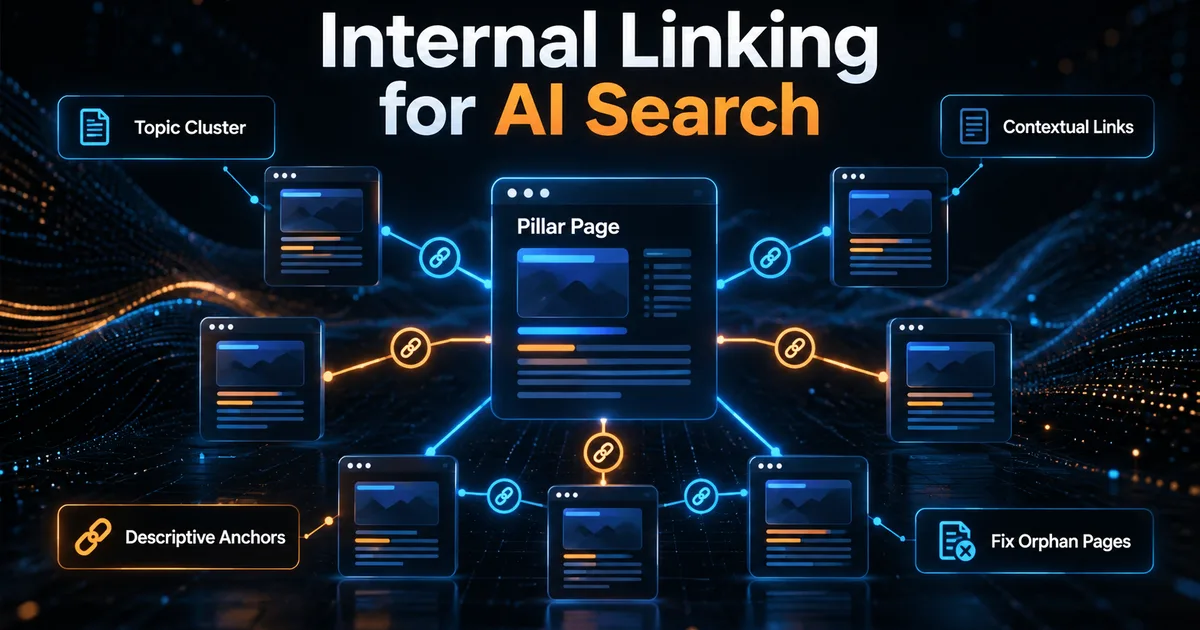
Internal linking is one of the highest-leverage SEO improvements because it helps people discover the next useful page while helping search engines understand how your content fits together.
It is also one of the easiest tactics to ruin with automation.
A good internal linking system is not "add five links to every article." It is a deliberate architecture where important pages receive relevant links, clusters have a clear center, anchors describe the destination, and readers are not forced through a maze of repetitive recommendations.
In AI search, that structure matters even more because content is often interpreted as part of a wider knowledge set. A single article can be useful, but a connected group of articles can demonstrate broader topical coverage and provide multiple paths for crawlers and users.
What Google actually says about internal links
Google's link best practices make several points that are easy to translate into a practical workflow:
- Important pages should have at least one internal link from another page.
- Links should generally use real
<a href>elements so they are crawlable. - Anchor text should be descriptive, concise and relevant.
- Context around a link matters.
- There is no magical ideal number of links per page.
That last point is important. Internal linking should be driven by usefulness, not a quota.
See Google's SEO link best practices.
Start with topic clusters, not random cross-links
A topic cluster has three layers:
- Pillar: a broad guide that explains the main topic.
- Supporting articles: deeper pages about specific subtopics.
- Commercial or product pages: pages where the user can act on what they learned.
For an AI visibility cluster, the pillar might be a Generative Engine Optimization guide.
Supporting content could include:
- How to Track AI Visibility
- AI Search ROI
- How to Get Cited in Google AI Overviews
- ChatGPT SEO
- Information Gain SEO
Each page should connect to the others only where the relationship helps the reader.
Use a hub-and-spoke model with sideways links
A basic hub-and-spoke model is helpful, but it can become too rigid.
Imagine a SaaS SEO hub linking to five supporting pages. If the supporting pages only link back to the hub, the structure says "these pages belong together" but does not explain the relationships between subtopics.
Add sideways links when two supporting pages solve adjacent problems.
Example:
- A guide about SaaS content strategy can link to a guide about information gain.
- A guide about AI search tracking can link to AI search ROI.
- A robots.txt guide can link to an AI crawler guide or AI agent optimization article.
This creates a semantic graph rather than a star shape.
Write anchor text for humans first
Good anchor text sets an expectation.
Weak:
- click here
- learn more
- read this
- this article
Better:
- AI visibility tracking framework
- SaaS SEO strategy
- Core Web Vitals guide
- Google AI Overview citation strategy
Avoid forcing exact-match keyword anchors into every link. Repetition can make the writing feel unnatural and can reduce clarity.
A simple test is to read the anchor by itself. Would you know what the linked page is about?
Build links into the argument, not the footer
Contextual internal links are usually more useful than dumping ten "related posts" at the bottom.
Suppose you are explaining why AI citations do not equal revenue. The natural next step is a link to an article explaining attribution and assisted conversions. That link helps because it extends the current thought.
By contrast, a footer widget that links to five random articles may be useful for discovery but says less about the semantic relationship between pages.
Use both if they serve different purposes, but prioritize links inside the content.
Find orphan pages before adding new links
An orphan page has no meaningful internal path from the rest of the site.
It may exist in the sitemap, but users and crawlers have a harder time discovering it naturally.
A simple audit process:
- Export all indexable URLs from your sitemap.
- Crawl the site and collect internal links.
- Compare the two lists.
- Flag pages with zero incoming internal links.
- Find the most relevant existing page that should link to each orphan.
Do not solve an orphan by adding it to a giant sitewide list unless that list is genuinely useful.
Use internal links to signal page roles
Not every page should compete for the same query.
Internal links can clarify which page is the main resource.
If you have three articles discussing AI visibility, decide which one is the broadest pillar. Then supporting pages can link to it using descriptive anchors. The pillar can link back to specific subtopics when readers need detail.
This reduces accidental cannibalization and gives the site a clearer hierarchy.
Avoid over-linking every repeated phrase
Automated internal linking tools often link every occurrence of a keyword. That creates noisy pages.
For example, if the phrase "AI visibility" appears 20 times, you do not need 20 links to the same guide.
A better pattern:
- Link the first meaningful occurrence.
- Link again only if a later section introduces a different reason to visit the destination.
- Avoid repeated links in adjacent paragraphs.
The user's reading experience should stay clean.
Treat product links differently from editorial links
Editorial links help explain a topic. Product links invite action.
If every educational paragraph pushes a product, the article starts to feel like a landing page instead of a guide.
A healthier structure is:
- Teach first.
- Link to supporting educational content where needed.
- Mention a product only where it genuinely solves the problem being discussed.
- Use a clear CTA near the end for readers who want to act.
This matters for trust and for AdSense-style content quality because the page should provide value independently of whether the reader becomes a customer.
Build a simple internal link scorecard
You do not need a proprietary tool to start. For each important article, track:
| Check | Target |
|---|---|
| Incoming contextual links | At least 2 relevant sources when possible |
| Outgoing internal links | Only useful next-step resources |
| Orphan status | No important page should be orphaned |
| Anchor quality | Descriptive and natural |
| Cluster relationship | Clear pillar or supporting role |
| Broken links | Zero |
The purpose is not to hit a number. It is to catch structural problems.
A practical 50-page workflow
For a site with roughly 20 to 50 articles, use this process once a month:
Step 1: Group content by intent
Create buckets such as:
- AI visibility
- SEO
- SaaS
- CRM automation
- conversion optimization
Step 2: Choose one or two pillars per bucket
Pick the pages that provide the broadest coverage and should receive the most supporting links.
Step 3: Review new articles
Every new article should answer:
- Which pillar should this page link to?
- Which existing article should link back to this page?
- Which sibling article would help the reader next?
Step 4: Check anchors
Replace vague anchors with descriptive ones.
Step 5: Remove stale links
If a page has been merged, redirected or removed, update the source links rather than leaving chains and dead ends.
Internal linking for AI search
There is no special "AI internal linking" markup. Google's own guidance for generative AI features says foundational SEO best practices still apply, including crawlability, useful content and good page experience.
That means internal linking for AI search is mostly about doing the basics well:
- Make pages discoverable.
- Explain relationships through context.
- Keep the architecture coherent.
- Avoid duplicate and low-value pages.
- Make the next useful resource easy to find.
See Google's guide to optimizing for generative AI features.
Common mistakes
Mistake 1: Linking only to the newest content
New does not automatically mean relevant. Older evergreen guides may be the better destination.
Mistake 2: Using the same anchor everywhere
Natural variation often produces clearer prose and prevents pages from looking mechanically optimized.
Mistake 3: Ignoring navigation
Contextual links are important, but category pages, blog indexes and breadcrumbs also help users understand where they are.
Mistake 4: Creating pages just to receive links
Do not create thin supporting pages to make a cluster look bigger. Google explicitly warns against scaled pages that add little value.
Mistake 5: Treating internal links as a one-time project
Every new article changes the network. Older articles may need new links when a better resource is published.
Final takeaway
A strong internal linking system is a navigation system, a crawl path and a map of your expertise at the same time.
Build clusters around real reader problems. Use descriptive anchors. Connect related subtopics. Remove orphan pages. Keep important resources easy to reach. And resist the temptation to automate links so aggressively that the site stops reading naturally.
If you want a wider content architecture framework, continue with Content Strategy for AI Search and Information Gain SEO.
References
- Google SEO link best practices
- Google Search Essentials
- Google generative AI optimization guide
- Google spam policies
Co-Founder of Strat IQ Digital and builder of CrawlerQue and Stratly Digital, based in West Palm Beach, FL. I work on AI products, SaaS, SEO intelligence, CRM automation and growth systems.