SEO Experimentation in 2026: How to Test Changes Without Fooling Yourself
A practical framework for SEO experiments covering hypotheses, page groups, metrics, seasonality, A B testing risks, rollout and interpretation.

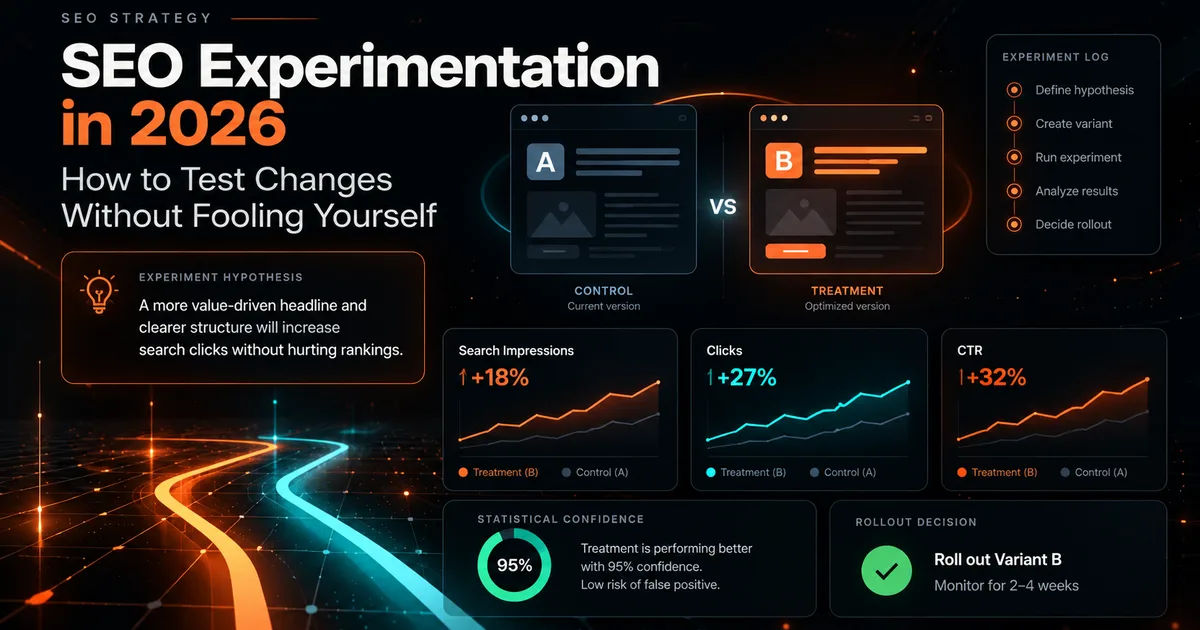
SEO teams often call any change followed by an improvement an experiment. That is not enough.
Traffic can move because of seasonality, ranking system changes, competitor activity, news, indexing delays, demand shifts or unrelated site changes. A useful SEO experiment needs a clear hypothesis, a controlled rollout where possible and a measurement window that matches the type of change.
Google provides specific guidance for keeping website A B tests compatible with Search, including avoiding cloaking. See Minimize A B testing impact in Google Search.
Start with a falsifiable hypothesis
Bad hypothesis:
Better internal linking will improve SEO.
Better hypothesis:
Adding two relevant contextual links from high traffic cluster pages to underlinked service pages will increase their organic impressions and discovery without reducing engagement on the source pages.
The second version says what changes, which pages are affected and which signals matter.
Choose one primary outcome
An experiment becomes hard to interpret when every metric is treated as success.
Choose one primary measure such as:
- Organic clicks.
- Non brand impressions.
- Qualified leads.
- Indexed page count for a technical change.
- CTR for a title experiment.
- Crawl discovery for internal linking.
Then define secondary metrics that explain side effects.
Use page groups when the site is large enough
For template or content changes, a useful design is to split comparable pages into a treatment group and a control group.
Examples:
- Service pages in similar markets.
- Product pages with similar traffic levels.
- Articles within the same content cluster.
Apply the change only to the treatment group and compare the relative movement.
This is not perfect laboratory science because search environments are noisy, but it is stronger than comparing one URL before and after a change.
Small sites need sequential testing
A personal site may not have enough comparable URLs for a clean split test.
Use a sequential framework instead:
- Document the baseline period.
- Make one meaningful change.
- Avoid unrelated changes to the same template during the test.
- Wait for recrawl and sufficient data.
- Compare query and page level behavior.
- Record alternative explanations.
The conclusion should reflect uncertainty.
"Traffic increased after the change" is stronger than "the change caused a 20 percent increase" unless your design supports the causal claim.
Title testing needs patience
Changing a title can affect click through rate, query matching and how Google generates a title link.
Google may create a title link from multiple sources and does not guarantee that the <title> element will be shown exactly as written. See Influencing title links in Google Search.
When testing titles:
- Keep the page intent unchanged.
- Change one dimension at a time.
- Record the old title.
- Watch query mix, not only average CTR.
- Check whether Google is actually showing the new title.
A higher CTR can be misleading if the page simultaneously loses broad impressions and is shown only for narrower queries.
Internal linking experiments
Internal links are useful experiment candidates because the implementation is controlled by the site owner.
A test might examine whether:
- Adding links from authoritative cluster pages improves discovery of underlinked pages.
- Descriptive anchors help users move deeper into a topic.
- Removing large repetitive link blocks improves usability without harming discovery.
Use links because they help navigation first. The experiment should not create unnatural anchor repetition.
For implementation principles, see Internal Linking for AI Search.
Content experiments should test usefulness
Avoid experiments whose only difference is keyword density.
Stronger variables include:
- Adding an original comparison table.
- Adding a troubleshooting section based on real failure modes.
- Publishing a methodology behind a claim.
- Consolidating two overlapping articles.
- Replacing generic introductions with direct answers.
- Adding an interactive calculator when the task benefits from one.
These changes affect the actual value of the page.
Technical SEO experiments
Technical changes often need different outcome metrics.
Example: moving from client rendered content to pre rendered HTML.
Primary outcomes could be:
- More consistent rendered content in URL Inspection.
- Faster discovery of internal links.
- Fewer indexing anomalies.
- Better LCP or INP.
Do not wait only for ranking movement if the change solves a technical reliability problem.
Avoid cloaking during tests
Google explicitly warns against showing one version to Googlebot and another to users.
If a test platform depends on cookies, remember that Googlebot generally does not behave like a normal returning user with cookies. Test configurations should remain understandable without using crawler specific treatment.
Define the observation window before looking at results
If you check a noisy metric every day and stop when it looks positive, you increase the chance of fooling yourself.
Write down:
- Start date.
- Expected recrawl delay.
- Minimum observation period.
- Primary metric.
- Stop condition.
- Known seasonal events.
Then evaluate on schedule.
Keep an SEO experiment log
A simple table can prevent repeated mistakes.
| Field | Example |
|---|---|
| Hypothesis | Contextual links improve discovery |
| Pages | 12 treatment, 12 comparison |
| Change date | 2026 10 01 |
| Primary metric | Non brand clicks |
| Secondary metrics | Impressions, leads |
| Confounders | Campaign launch on week 2 |
| Result | Positive, neutral or negative |
| Confidence | Low, medium or high |
| Decision | Roll out, revert or retest |
Do not delete failed experiments. They are part of the site's operational knowledge.
Measure business outcomes too
More traffic is not always the right result.
For a service site, a test that produces fewer visits but more qualified inquiries may be better than a traffic increase that attracts the wrong audience.
For SaaS, connect organic changes to trial starts, activation and retained usage where privacy and analytics implementation allow.
Final checklist
Before calling something an SEO experiment, confirm:
- There is a written hypothesis.
- One primary metric exists.
- The affected pages are documented.
- The baseline is recorded.
- Other changes are minimized.
- The test does not cloak content.
- The observation window is defined in advance.
- Results include uncertainty and alternative explanations.
- Business outcomes are considered when relevant.
SEO testing is valuable not because it makes search perfectly predictable, but because it forces teams to replace confident guesses with documented learning.
Co-Founder of Strat IQ Digital and builder of CrawlerQue and Stratly Digital, based in West Palm Beach, FL. I work on AI products, SaaS, SEO intelligence, CRM automation and growth systems.