Query Fan Out in AI Search: How to Map Content to Complex Search Journeys
Understand query fan out in AI search and build content around subtopics, comparisons, evidence and follow up questions without creating thin keyword pages.

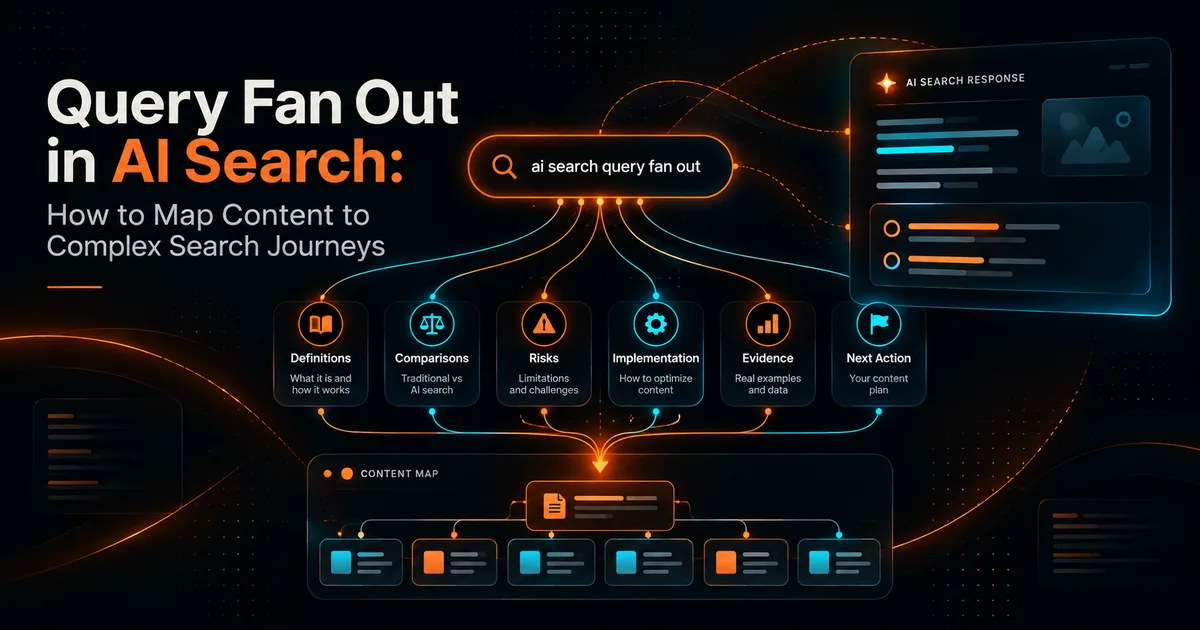
Traditional keyword planning often starts with one query and one target page. AI search can make that model too narrow.
Google explains that AI Overviews and AI Mode may use a query fan out technique. The system can issue multiple related searches across subtopics and data sources while building a response. That creates an important content strategy implication: a useful page should answer the core question while connecting naturally to the supporting questions a serious user is likely to ask next.
Google documents query fan out in AI features and your website.
Query fan out does not mean publish every keyword variation
The wrong response is to create dozens of nearly identical pages.
If a person searches for "best CRM for a small agency," related information needs might include:
- What features matter for an agency?
- How should leads be assigned?
- How are follow ups automated?
- How should call activity be stored?
- What permissions should team leads have?
- How much integration complexity is reasonable?
Those are meaningfully different questions. They can be covered in one comprehensive guide or a connected cluster when each subtopic deserves depth.
Creating pages for "best CRM for small agency," "best CRM for tiny agency" and "best CRM for small marketing agency" with mostly duplicated text is not a content strategy.
Build a question graph before a keyword list
A practical workflow starts with a primary decision or problem.
Example primary problem:
How should a service business automate lead follow up without losing ownership and context?
Then map six question types around it.
Definitions
What does the user need to understand first?
Process
What steps does the user need to perform?
Comparison
What options must the user evaluate?
Risk
What can go wrong?
Evidence
What data, examples or criteria help the user trust the recommendation?
Next action
What should the user do after understanding the topic?
This creates a richer map than a spreadsheet containing only search volume.
Decide whether a subtopic deserves its own page
Use three tests.
Intent independence
Can someone have this question without needing the parent article?
Depth
Can you provide substantial information that would make the page useful by itself?
Internal connection
Can the page link naturally to related pages without feeling forced?
If all three are true, a separate page may be justified. If not, the content probably belongs as a section within a broader guide.
Use one canonical page for one clear job
Every page should have a reason to exist.
A strong page might be the definitive implementation guide for lead routing. Another might be a detailed explanation of CRM data hygiene. They can link to each other, but they should not compete for the same promise.
This helps users and also reduces internal cannibalization.
For a deeper architecture approach, see Internal Linking for AI Search.
Add evidence layers
AI search systems can surface links that support different parts of a response. Generic summaries are easy to replace. Evidence gives a page a stronger reason to be selected.
Useful evidence layers include:
- Original screenshots.
- Real configuration examples.
- Decision tables.
- Before and after architecture diagrams.
- Reproducible calculations.
- Public data with transparent sourcing.
- Clearly labeled observations from implementation work.
If you have first party data, publish the methodology rather than only the conclusion. See Original Research for AI Search.
Map the user journey, not only the query
A complex search often moves through stages.
| Stage | User question | Useful content |
|---|---|---|
| Understand | What is this? | Clear explanation |
| Diagnose | Is this my problem? | Symptoms and checks |
| Evaluate | Which approach should I choose? | Comparison framework |
| Implement | How do I do it? | Steps and examples |
| Validate | Did it work? | Metrics and tests |
| Maintain | What can break later? | Monitoring checklist |
A high value article often covers several stages while linking to deeper pages for implementation details.
Use answer first writing without flattening the article
A clear answer near the top is useful, but not every paragraph should become a one sentence snippet.
A strong structure is:
- Give the direct answer.
- Explain the reasoning.
- Show exceptions.
- Give an implementation method.
- Add evidence or examples.
- Link to the next useful decision.
That structure works for human readers because it respects both speed and depth.
Avoid query fan out theater
Do not invent a list of "AI subqueries" and present them as if you can see the internal searches a system used for a specific response.
Google explains the technique at a high level. Site owners normally do not receive a complete internal trace of every query issued for every AI response.
Instead, use query fan out as a planning model: cover the real subproblems a user must solve.
A practical content mapping exercise
Take one important topic and create a table with these columns:
- Primary user goal
- Subquestion
- Existing URL
- Evidence available
- Missing information
- Best format
- Internal links needed
- Conversion or next action
Then classify each row:
Keep: an existing page already handles it well.
Expand: the existing page needs more evidence or depth.
Create: the subproblem is important enough for a dedicated page.
Merge: two pages are competing for the same user need.
This method can prevent the common mistake of adding content volume without adding value.
What to measure
Do not judge the strategy only by ranking position.
Track:
- Organic impressions and clicks by topic cluster.
- Growth in long tail queries around the core topic.
- Internal click paths between related articles.
- Assisted conversions from informational pages.
- Brand mentions and citations in relevant AI answers.
- Pages that receive impressions but weak engagement.
- Pages that overlap in query footprint.
For AI specific measurement, see How to Track AI Visibility.
Final checklist
Before creating a new article from a related query, ask:
- Does this page solve a distinct problem?
- Can it provide evidence or implementation detail not already published?
- Does it fit a clear place in the topic architecture?
- Is there a natural internal link from an existing page?
- Would the article still be useful if search volume were zero?
- Are we adding knowledge or only changing wording?
Query fan out is useful because it reminds content teams that real questions branch. The strategy is not to publish every branch. The strategy is to build the most useful paths through the branches that matter.
Co-Founder of Strat IQ Digital and builder of CrawlerQue and Stratly Digital, based in West Palm Beach, FL. I work on AI products, SaaS, SEO intelligence, CRM automation and growth systems.