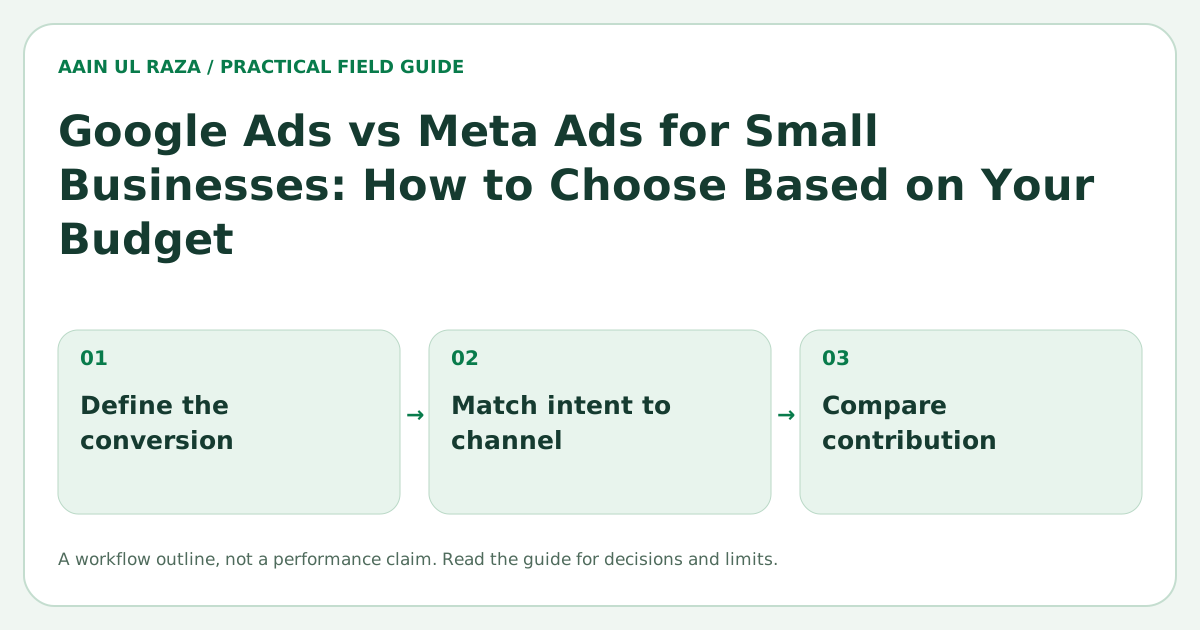
Google Ads vs Meta Ads for Small Businesses: How to Choose Based on Your Budget
Compare Google Ads and Meta Ads using intent, audience targeting, sample budgets, CPC, conversion goals and practical decision rules.
Updated · Sources, examples and corrections
Small businesses often ask the same question: Should I spend my budget on Google Ads or Meta Ads? The honest answer is that both platforms can work, but they solve different problems.
Google Ads is usually stronger when people already know what they want and are actively searching. Meta Ads is often stronger when you need to create awareness, generate interest and target people based on behavior or interests.
The best choice depends on customer intent, your offer, your budget and how quickly you need results.
The core difference
Google Ads
Google Ads captures existing demand. People are already searching for something.
Examples:
- accountant near me
- buy office chair online
- crm for small business
- emergency plumber in rawalpindi
This makes Google strong for high intent leads.
Meta Ads
Meta Ads helps create or expand demand and awareness. You target people by interests, demographics, behavior or lookalike audiences.
Examples:
- promoting a new product launch
- generating awareness for a service brand
- retargeting website visitors
- reaching a niche audience before they search
This makes Meta strong for discovery and remarketing.
When Google Ads is usually the better choice
Google Ads is often the better starting point when:
- People are already searching for your service
- You need leads quickly
- Your offer solves an urgent problem
- Local intent matters
- You can convert inbound demand well
Examples include:
- Legal services
- Plumbers and electricians
- Accountants
- Medical clinics
- Software with clear search demand
When Meta Ads is usually the better choice
Meta Ads is often stronger when:
- Your product is visually appealing
- You need to build awareness first
- You want to educate the market
- Retargeting is part of your funnel
- Interest based targeting fits the audience
Examples include:
- Fashion or lifestyle products
- Fitness offers
- Coaching programs
- Interior products
- New consumer brands
Comparing cost and intent
Here is a practical comparison:
| Area | Google Ads | Meta Ads |
|---|---|---|
| User intent | High | Low to medium |
| Awareness | Moderate | Strong |
| Demand capture | Excellent | Moderate |
| Audience targeting | Good | Excellent |
| Creative importance | Moderate | Very high |
| Landing page dependence | High | High |
| Best for local search | Excellent | Moderate |
| Best for visual discovery | Weak | Excellent |
Sample budget comparison
Suppose a small business has $1,000 per month.
Example Google Ads scenario
- Average CPC = $1.24
- Clicks = around 806
- Landing page conversion rate = 8%
- Leads = about 64
Example Meta Ads scenario
- Average CPC = $0.86
- Clicks = around 1,162
- Landing page conversion rate = 3.5%
- Leads = about 41
In this simple example, Google gets fewer clicks but more leads because intent is higher.
Now imagine a visually appealing ecommerce product where Meta creative performs well. The result could reverse, especially when retargeting is added.
Think about the full funnel
A common mistake is comparing only platform CPC. Lower CPC does not automatically mean better results.
You should compare:
- CPC
- Conversion rate
- Cost per lead or sale
- Lead quality
- Time to conversion
- Assisted conversions
Meta often helps earlier in the journey. Google often helps later, when the user is ready to act.
How budget size changes the decision
Very small budget
If budget is tight, choose the platform that matches the clearest buying intent.
- Local service business: Google often wins
- Visual product with strong content: Meta may win
Medium budget
With more budget, testing both may make sense.
- Google for demand capture
- Meta for awareness and retargeting
Larger growth budget
A full funnel strategy often performs best:
- Meta creates demand
- Google captures high intent searches
- Retargeting keeps the brand visible
Decision rules for small businesses
Choose Google Ads first if:
- Search demand already exists
- You want form leads or calls
- Your sales cycle starts with active need
- You serve a clear local area
Choose Meta Ads first if:
- The offer needs education
- Creative storytelling matters
- The audience can be identified by interests or lifestyle
- You want demand generation and remarketing
Use both if:
- Budget allows consistent testing
- Your funnel needs awareness and capture
- You want stronger brand recall and more touchpoints
Common mistakes
- Choosing based only on CPC
- Running Meta without strong creative
- Running Google without a solid landing page
- Ignoring audience quality
- Ending tests too early
- Failing to track leads back to the source
How to test smartly
If budget allows, run a four to six week test with:
- Clear conversion goals
- Clean attribution setup
- Separate landing pages if needed
- Consistent follow up process
At the end, compare cost per qualified lead or cost per profitable sale, not just clicks.
Match the platform to the buying journey
The strongest comparison starts with the customer's path to purchase. If buyers usually recognize a problem and immediately search for a provider, Google has a natural advantage. If buyers need inspiration, education or repeated exposure before they know what to search for, Meta can play a bigger role.
Map the journey in three stages: discovery, evaluation and action. Then decide which platform is best suited to each stage. A business does not need both platforms on day one, but it should understand where each could fit later.
Use contribution margin, not revenue, to judge results
A campaign that produces $10,000 in sales is not automatically better than one that produces $7,000. You need to know the margin after product or service delivery cost.
For ecommerce, compare ad spend against contribution margin after cost of goods and fulfillment. For service businesses, compare cost per qualified lead and cost per acquired customer against expected gross profit.
This avoids the common mistake of scaling a campaign that looks strong in revenue but weak in profit.
Build a fair test budget
A platform test should generate enough conversions to teach you something. If the budget is so small that a campaign receives only a few clicks per day, performance can look random.
Instead of splitting a tiny budget across many campaigns, concentrate it. Test one or two offers, a small number of audiences or keyword groups, and a clear conversion event. Once you have evidence, expand.
Compare lead quality, not only lead cost
Meta may produce cheaper form fills while Google produces fewer but stronger leads. Or the opposite may happen. Add a simple CRM field for source and track downstream outcomes such as booked call, qualified opportunity and closed customer.
A $20 lead that never replies is more expensive than a $60 lead that closes regularly. The CRM is where advertising performance becomes business performance.
Know when to combine the platforms
A combined strategy becomes useful when each platform has a clear job. Meta can expose the brand to relevant audiences and retarget visitors. Google can capture people who later search for the brand, service or problem.
When both are running, use consistent offers and strong analytics so you do not double count success. The purpose is not to prove which platform wins. The purpose is to create a better customer acquisition system.
Use a simple budget allocation framework
If you are unsure how to split a limited budget, start with the platform that serves the strongest current intent and reserve a smaller amount for learning. For a local service business, that may mean most of the first budget goes to Google while a smaller Meta campaign tests retargeting or awareness. For a visual consumer product, the order may reverse. Review the split only after you have enough qualified lead or sale data. Budget allocation should follow evidence, not habit.
Measurement needs an event definition
Google’s event documentation shows how to define and verify measurable actions. The channel-comparison framework here is not a universal recommendation about which platform is cheaper. Compare qualified leads and eventual sales using consistent definitions and real account data.
Compare qualified contribution with the same definitions
Use this hypothetical comparison only as a worksheet. Campaign A spends $600 and generates 12 leads, six qualified opportunities and two sales. Campaign B spends $600 and generates 30 leads, three qualified opportunities and one sale. The cheaper raw lead is not necessarily the better business outcome.
If contribution per sale is $400 for both, A produces $800 before ad spend and B produces $400. That leaves $200 and minus $200 respectively before campaign labor and other costs. Attribution uncertainty, sales delay and sample size still matter.
Use a shared qualified-lead definition and the same revenue window before comparing platforms. Keep view-through and click-attributed results labeled, and deduplicate sales in your own records. Read Google Ads conversion tracking guidance for platform setup; a reported conversion is still subject to the chosen measurement rules.
Further reference: Google Analytics event-collection documentation.
Frequently Asked Questions
Is Google Ads always better for lead generation?
Not always, but it is often stronger for high intent lead generation because the user is actively searching.
Is Meta cheaper than Google?
Meta often has a lower CPC, but lower CPC does not guarantee lower cost per lead or sale.
Can small businesses run both platforms?
Yes, if budget and tracking are good enough. Many businesses use Meta for awareness and Google for capture.
Which platform needs better creative?
Meta usually depends more heavily on strong creative because you are interrupting attention rather than capturing search intent.
How long should I test before deciding?
A useful first test often takes four to six weeks, depending on traffic volume and the sales cycle.

Co-Founder of Strat IQ Digital and builder of CrawlerQue and Stratly Digital, based in West Palm Beach, FL. I work on AI products, SaaS, SEO intelligence, CRM automation and growth systems.