How to Calculate Amazon PPC Break Even ACoS and Target ACoS
A step by step guide to break even ACoS and target ACoS with formulas, examples, profit margins and practical Amazon PPC strategy.
Updated · Sources, examples and corrections
If you run Amazon ads, one of the most important questions is simple: How much can I spend on advertising and still stay profitable? That is where break even ACoS and target ACoS come in.
Break even ACoS tells you the maximum advertising cost of sales you can afford before profit drops to zero. Target ACoS helps you choose a more practical goal based on your growth stage, margins and business priorities.
Once you understand these two numbers, your Amazon PPC decisions become much smarter.
What is ACoS?
ACoS stands for Advertising Cost of Sales.
Formula:
ACoS = Ad Spend ÷ Ad Sales × 100
Example:
- Ad spend = $200
- Ad sales = $1,000
ACoS = 200 ÷ 1000 × 100 = 20%
This means you spent 20 cents on ads for every $1 in ad revenue.
What is break even ACoS?
Break even ACoS is the highest ACoS you can afford before profit becomes zero.
In most practical Amazon PPC discussions:
Break even ACoS = Profit Margin
If your profit margin is 30%, then your break even ACoS is 30%. If your ads run above 30%, you are likely losing money on each sale.
How to calculate profit margin
To find break even ACoS, calculate your profit margin first.
Basic profit margin formula
Profit Margin = Profit per unit ÷ Selling price × 100
Example
Selling price = $24.99
Costs per unit:
- Product cost = $6.50
- Shipping to Amazon = $1.20
- Amazon referral fee = $3.75
- FBA fee = $4.00
- Other landed costs = $1.00
Total non ad cost = $16.45
Profit before ads = $24.99 - $16.45 = $8.54
Profit margin = $8.54 ÷ $24.99 × 100 = 34.2%
That means your break even ACoS is about 34.2%.
What is target ACoS?
Target ACoS is the ACoS goal you choose for your campaigns. It is usually lower than break even ACoS because you still want profit.
For example:
- Break even ACoS = 34.2%
- Desired profit buffer = 8%
- Target ACoS = around 26%
Target ACoS is not fixed for every campaign. Different campaigns can have different targets based on their purpose.
Choosing a target ACoS by campaign goal
Ranking or launch campaigns
You may accept a higher ACoS to win visibility and initial sales.
Stable profit campaigns
You usually want a lower ACoS to protect margin.
Branded campaigns
These often deserve a lower target because they usually convert well and should be efficient.
Product targeting or competitor campaigns
These may need a higher target if they assist discovery but convert less efficiently.
A step by step method to set target ACoS
Step 1: Find break even ACoS
Calculate your real margin after Amazon fees and all landed product costs.
Step 2: Decide your goal
Ask whether you want growth, visibility, margin or liquidation.
Step 3: Set your profit buffer
Most sellers do not want to spend right up to break even. Leave room for profit.
Step 4: Create campaign level targets
Set different targets for branded, non branded, auto, product targeting and remarketing style campaigns.
Step 5: Review conversion rate and CPC
A target ACoS that ignores CPC and conversion rate is weak. Better conversion rates can support higher CPC while still staying profitable.
Connecting CPC, conversion rate and target ACoS
A helpful practical relationship is:
Target ACoS ≈ (CPC ÷ Price) ÷ Conversion Rate
Rearranged for acceptable CPC:
Acceptable CPC = Target ACoS × Price × Conversion Rate
Example
- Price = $24.99
- Target ACoS = 25%
- Conversion rate = 12%
Acceptable CPC = 0.25 × 24.99 × 0.12 = $0.75
If your actual CPC is much higher than $0.75, you may struggle to hit the target unless conversion rate improves.
Practical example
Product:
- Selling price = $30
- Profit before ads = $9
- Break even ACoS = 9 ÷ 30 × 100 = 30%
Now choose target ACoS:
- Conservative profit target = 18%
- Balanced target = 22%
- Growth target = 27%
Each target changes how aggressively you bid.
What this means in practice
At 18% target ACoS:
- You prioritize efficiency
- You may win fewer auctions
- Profit per order stays stronger
At 27% target ACoS:
- You can bid more aggressively
- You may gain more visibility
- Profit per order becomes thinner
Common PPC decisions using ACoS
When ACoS is above target
Check:
- Search terms wasting spend
- Bids that are too high
- Poor product page conversion
- Bad match type structure
- Low relevance traffic
When ACoS is below target
You may be able to:
- Increase bids
- Increase budgets
- Expand keyword coverage
- Push top converting terms harder
When ACoS is below break even but above target
This often means the ads are still profitable, but not profitable enough for your current goal.
What many sellers get wrong
They use only average account ACoS
Average ACoS hides what is happening by campaign, keyword and search term.
They forget margin differences
If products have different margins, they need different break even ACoS numbers.
They ignore TACoS
Total ACoS matters too, because ads may help overall sales beyond direct ad attribution.
They block useful keywords too quickly
A term may look inefficient early on but still assist discovery or convert later with better optimization.
Quick Amazon PPC worksheet
For each product, record:
- Selling price
- Product cost
- Referral fee
- FBA fee
- Other landed cost
- Profit before ads
- Break even ACoS
- Target ACoS
- Conversion rate
- Acceptable CPC
This worksheet gives you a much better foundation for bidding and optimization.
Practical decision worksheet
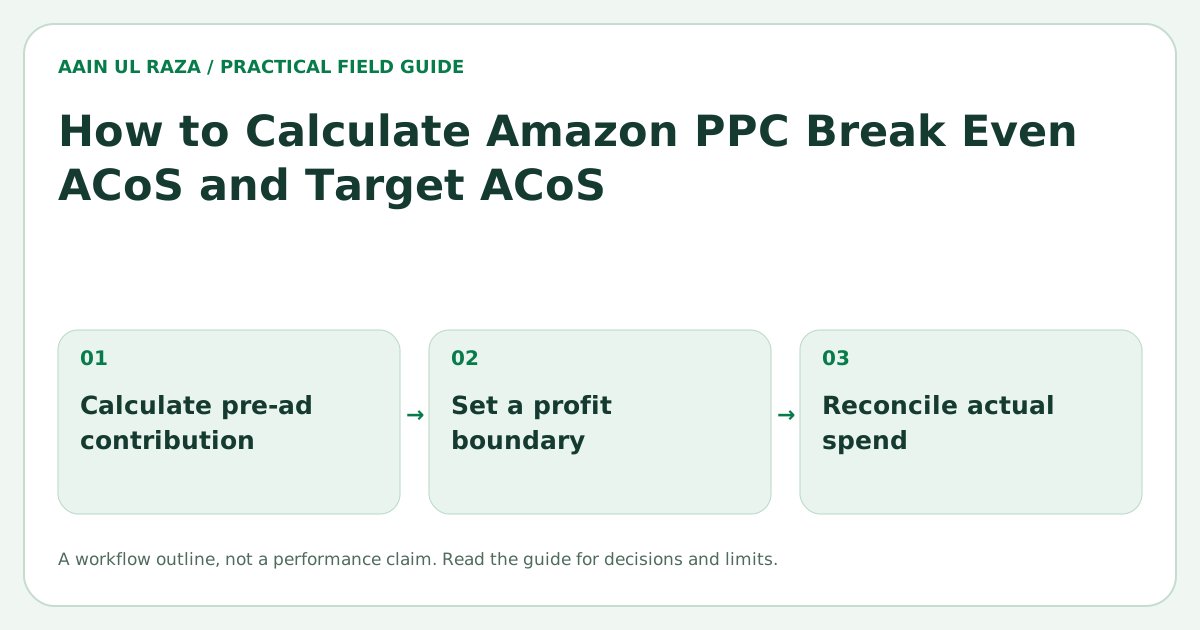
To check the unit economics before changing bids, use the blank PPC cost and profit worksheet. Record actual price, all variable costs and the attribution period, then calculate both your break even and your desired profit boundary. The worksheet does not claim to contain campaign results.
Include all costs before trusting your margin
The most common break even ACoS mistake is using an incomplete profit margin. Sellers sometimes subtract only product cost and Amazon fees while forgetting freight, prep, packaging, discounts, returns and other costs that reduce contribution margin.
For PPC decisions, build a contribution margin that reflects the costs you actually incur before advertising. If a product sells for $30 and appears to have a 35% margin before you include an extra $2 of landed cost, your true break even ACoS may be several points lower than expected. That difference matters when campaigns operate near the profitability line.
Use different targets for different stages
One target ACoS for the entire account is usually too simple. Campaigns have different jobs.
A launch campaign may accept a higher ACoS while the product builds sales history. A branded campaign may have a much lower target because conversion is stronger. A proven exact match keyword may deserve aggressive bidding because its economics are predictable. A discovery campaign may need a capped budget and looser efficiency target because its job is to find new search terms.
The important point is that target ACoS should be connected to purpose, not applied blindly.
Connect ACoS to profit per order
ACoS becomes easier to understand when you convert it back into dollars.
Suppose a product sells for $40 and has $12 profit before advertising. Break even ACoS is 30%. If the campaign runs at 20% ACoS, ad cost per order is about $8, leaving roughly $4 contribution after advertising. At 28% ACoS, ad cost per order is about $11.20, leaving only $0.80.
Both campaigns are below break even, but the first creates much more usable profit. This is why "profitable" and "healthy" are not the same thing.
Use a decision table for campaign management
A simple operating table can reduce emotional PPC decisions:
| Situation | Possible action |
|---|---|
| ACoS below target and conversion strong | Consider raising bids or budget |
| ACoS near target and stable | Maintain and monitor |
| ACoS above target but below break even | Optimize bids and search terms |
| ACoS above break even with enough data | Reduce bids, isolate or negate waste |
| Low data volume | Wait for more evidence before major changes |
The phrase "with enough data" matters. PPC decisions based on a handful of clicks can create more harm than good.
Recalculate when economics change
Break even ACoS is not permanent. Recalculate when selling price changes, Amazon fees change, landed cost changes, promotions run or the product mix changes. A target that was safe three months ago can become unprofitable after a cost increase.
A disciplined seller keeps a product level margin sheet and updates it regularly. That turns ACoS from a reporting metric into a real financial control.
Test your unit economics before changing bids
Use a hypothetical product priced at $30, with $18 in non-ad costs. The contribution available before advertising is $12. Break-even ACoS is $12 / $30 = 40%, while an illustrative $3 target profit leaves $9 for advertising, or 30% target ACoS. Those percentages can change when returns, coupons, storage or fees change. This arithmetic does not mean a 30% ACoS is ideal for every campaign.
Before modifying bids, check the date range and attribution window in the actual Sponsored Products report. Match that report to the same SKU economics sheet, not an account-wide average margin. Recalculate the threshold after a fee or selling-price change. Do not conflate advertising-attributed orders with total organic and paid orders.
Try the free ACoS and contribution calculator. It processes values in your browser and labels examples as hypothetical. Compare its output with your own accounting data before making a financial decision.
Check the platform metric before modeling profit
Amazon defines ACoS as ad spend divided by attributed ad sales. The margin calculation here is a separate seller-side profitability model; Amazon’s ACoS definition alone does not establish profit after returns, fees, discounts and organic sales effects.
Recalculate after a discount
A fictional product sells for $30 with $18 of non-ad costs and a desired $3 contribution. Break-even ACoS is 40%; the target after the contribution goal is 30%.
If a discount lowers the realized price to $27 while those costs remain $18, break-even falls to 33.33% and the target becomes 22.22%. A campaign still showing 28% ACoS no longer meets the same $3 unit contribution goal.
Use the realized revenue and relevant costs for the period, not a list price from last month. Review fees, coupons and returns consistently. Enter both scenarios in the profit calculator. The calculation is a planning model; advertising attribution, mixed products and reporting lag can prevent campaign averages from matching a single-unit example.
Further reference: Amazon Ads ACoS definitions.
Frequently Asked Questions
Is break even ACoS always the same as profit margin?
In practical Amazon PPC management, yes, that is the standard rule. It is a useful shortcut as long as your profit margin is calculated correctly before ad spend.
Should target ACoS always be lower than break even ACoS?
Usually yes, because you still want profit. The only exception is when you temporarily accept thinner margins for launch or ranking goals.
Can two campaigns for the same product have different target ACoS values?
Yes. Branded campaigns, competitor campaigns and launch campaigns often deserve different targets.
What if my conversion rate changes?
Then your acceptable CPC and target ACoS logic should be reviewed, because conversion rate directly affects how much you can bid.
Is a low ACoS always good?
Not always. A very low ACoS may mean you are being too conservative and missing volume.

Co-Founder of Strat IQ Digital and builder of CrawlerQue and Stratly Digital, based in West Palm Beach, FL. I work on AI products, SaaS, SEO intelligence, CRM automation and growth systems.